To use perceived exertion for better pacing, focus on how your body feels during exercise—notice your breathing, muscle fatigue, and effort levels. Aim to work harder during intense intervals and ease up during recovery, trusting your body’s signals. Practice tuning into these sensations regularly; over time, you’ll better recognize your limits and adjust effort accordingly. Keep exploring these techniques to unleash even more ways to optimize your workouts naturally and effectively.
Key Takeaways
- Continuously assess muscle fatigue, breathing, and effort to adjust intensity in real-time during workouts.
- Use perceived exertion to stay within target zones, such as “moderate” for steady efforts or “hard” for intervals.
- Practice listening to your body’s signals to develop accurate effort awareness over time.
- Switch between effort levels intuitively during intervals to optimize performance and recovery.
- Avoid overexertion by backing off when effort feels too intense or unsustainable.

Pacing your workouts effectively can be challenging, especially when you don’t have access to gadgets or heart rate monitors. Without these tools, it’s easy to either push too hard or hold back too much. That’s where perceived exertion comes into play. By tuning into how hard you feel like you’re working, you can better manage your effort throughout your workout. This method works well with interval training, where alternating between high and low effort is key, and understanding your heart rate zones can help you gauge your intensity without constant monitoring.
Perceived exertion helps you pace effectively without gadgets, guiding effort and intensity during interval training.
When you pay attention to perceived exertion, you listen to your body’s signals — how your muscles feel, your breathing rate, and overall fatigue. For example, during high-intensity intervals, you should feel like you’re working hard, breathing heavily, but still able to sustain the effort briefly. During recovery periods, your perceived exertion should drop, and you should feel more comfortable and able to recover. This approach allows you to adapt on the fly, ensuring you’re not overdoing it or underperforming. Developing a sense of effort over time can also improve your overall awareness of your physical limits and capabilities.
Using perceived exertion doesn’t mean you ignore your heart rate zones entirely, but rather that you develop a sense for them. Heart rate zones are based on your maximum effort and help you determine which zone you’re in — from easy recovery to maximum effort. When you gauge your perceived exertion, you’re fundamentally estimating your position within those zones. For instance, feeling like you’re working at a “hard” level corresponds roughly to Zone 3 or 4, while “very hard” aligns with Zone 5. Over time, this awareness helps you maintain consistency and intensity appropriate for your goals, whether it’s endurance, speed, or recovery.
You’ll find that with practice, your perception of effort becomes more accurate, making your workouts more effective. Instead of relying on gadgets, you develop a natural sense of pacing, which is especially useful when equipment isn’t available. During longer runs or rides, this skill helps prevent burnout by avoiding pushing too hard early on or conserving too much energy for later. Plus, it keeps you more engaged, as you’re actively listening to your body rather than obsessing over numbers. Recognizing your body’s signals is a key component of mastering perceived exertion and optimizing your training.
Ultimately, mastering perceived exertion gives you greater control over your training. It simplifies interval training by allowing you to intuitively switch between high and low effort, aligning your effort with your fitness level and goals. As you become more attuned to how you feel, you’ll notice improvements in your performance, recovery, and enjoyment of your workouts. It’s a simple, effective way to pace yourself better — no gadgets required.
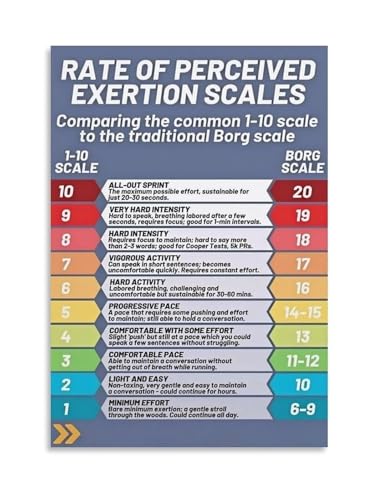
Fitness RPE Scale Poster Rate of Perceived Exertion 1-10 Borg Scale Workout Intensity Chart Crossfit Box Wall-Art Decor(Unframed,12X18inch(30X45cm))
We have reserved a 0.6in (1.5cm) white margin for you, which is convenient for you to frame with…
As an affiliate, we earn on qualifying purchases.
As an affiliate, we earn on qualifying purchases.
Frequently Asked Questions
Can Perceived Exertion Replace Heart Rate Monitoring?
Perceived exertion can replace heart rate monitoring for training intensity, but it depends on your consistency and awareness. You rely on subjective feedback to gauge how hard you’re working, which works well if you’re attentive and experienced. However, heart rate monitors provide more precise data, especially for beginners or those with health concerns. Combining both methods gives you a thorough view, helping you train effectively and safely.
How Accurate Is Perceived Exertion for Beginners?
Perceived exertion is fairly accurate for beginners, especially when it comes to maintaining training consistency and managing fatigue. You might find it challenging initially to gauge effort precisely, but with practice, you’ll learn to trust your body’s signals. This method helps prevent overtraining, ensuring you stay consistent without risking burnout. Over time, your perception of effort becomes a reliable tool for pacing workouts and promoting steady progress.
Should Perceived Exertion Vary Between Different Exercise Types?
Yes, perceived exertion should vary between different exercise types because each demands different levels of effort and energy. By tuning into your perceived exertion, you maintain exercise consistency and avoid overtraining. It also helps you stay mentally focused, ensuring you push yourself appropriately without risking burnout. Recognizing these differences allows you to adapt your pace effectively, making your workouts more efficient and enjoyable.
How Often Should I Reassess My Perceived Exertion During a Workout?
Reassess your perceived exertion regularly—every 5 to 10 minutes—to maintain mindful measurement and maximize exercise consistency. You’ll want to check in when mental fatigue begins to surface or as your workout progresses, ensuring you avoid overexertion. Staying attentive helps you adapt effort levels, preventing burnout and building better stamina. Frequent feedback allows you to fine-tune your pacing, making each session safer, smarter, and more satisfying.
Can Perceived Exertion Help Prevent Overtraining?
Yes, perceived exertion can help prevent overtraining by helping you listen to your body. When you monitor how hard you feel you’re working, you maintain training consistency without pushing too hard. This awareness also builds mental resilience, making it easier to recognize fatigue or signs of overtraining early. By adjusting your effort based on perceived exertion, you can avoid burnout and stay healthy, ensuring steady progress in your fitness journey.

Fitness Trackers, No Bluetooth No APP/Phone Needed, 1.8" Fitness Watch for Men Women with Pedometer Heart Rate/Blood Oxygen/Sleep Monitor 100 Sports, Steps Counter Walking Running Waterproof Black
[Non Bluetooth, No App No Phone Nedded Pedometer Watch]: This pedometer watch works completely on its own. No…
As an affiliate, we earn on qualifying purchases.
As an affiliate, we earn on qualifying purchases.
Conclusion
By tuning into your perceived exertion, you become the captain of your own workout ship, steering smoothly through each phase with confidence. It’s like having a personal compass that guides you to push just enough without overdoing it. Trusting your body’s signals helps you build endurance, avoid burnout, and enjoy your progress more. So, next time you work out, listen closely—your body’s the best guide, and your effort level is the map to success.
interval training effort gauge
As an affiliate, we earn on qualifying purchases.
As an affiliate, we earn on qualifying purchases.

Recovery and Stress in Sport: A Manual for Testing and Assessment
As an affiliate, we earn on qualifying purchases.
As an affiliate, we earn on qualifying purchases.