TL;DR

Get workout gear delivered free with Prime
- Fast, free delivery on millions of items
- Prime Video, Amazon Music and more included
- Member-only deals all year
Fit&Well published a 15-minute, equipment-free leg circuit featuring squats, reverse lunges, glute bridges and lateral lunges. Its guidance suggests beginners start with three circuits, add rest as needed and stop if they feel sharp pain. The report does not provide evidence that the routine produces a particular strength or muscle-building result.
Fit&Well has published a four-move leg workout that can be done at home in about 15 minutes without equipment. The time-based circuit uses squats, reverse lunges, glute bridges and lateral lunges, with the report advising beginners to start with fewer rounds and take extra rest.
The routine is set up as a circuit: perform each movement for 30 seconds, then move to the next. After completing all four exercises, rest for one minute before starting again. Fit&Well says five rounds should take roughly 15 minutes, though the total time may vary if someone adds rest between exercises.
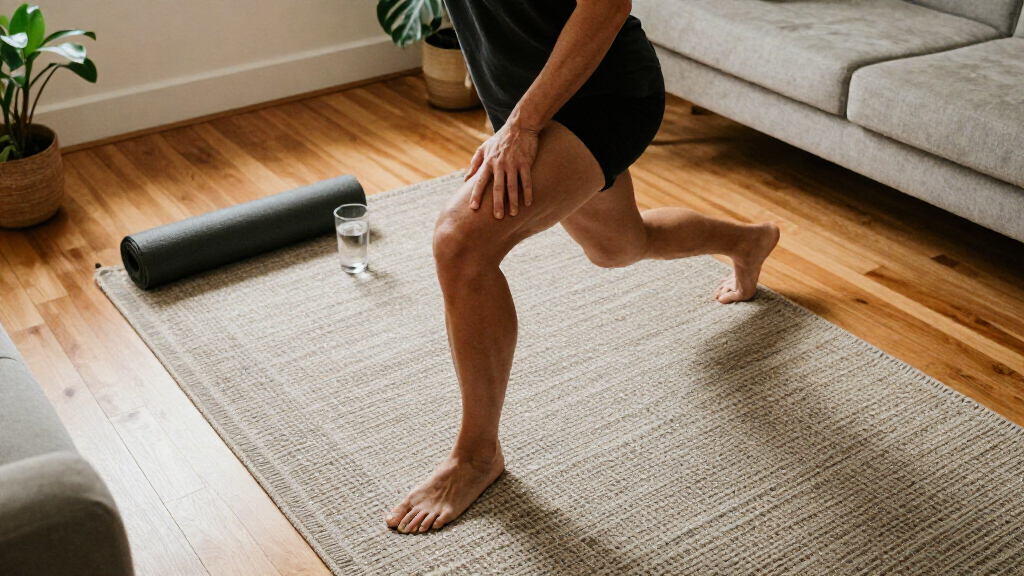
The exercises work the lower body through different movement patterns. Squats involve bending at the hips and knees; reverse lunges alternate steps backward; glute bridges are performed lying on the back, lifting the hips; and lateral lunges step from side to side. The report recommends maintaining an upright chest during the squat and lunges, keeping the front knee aligned over the foot in a reverse lunge, and avoiding an arched lower back during a glute bridge.
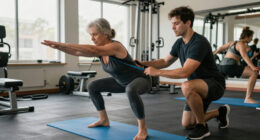
No weights or other equipment are required, but the routine needs enough clear floor space to move safely. The source advises people who are new to exercise to seek help from a personal trainer for form and modifications. It also suggests using a sturdy chair or similar support if balance is an issue during reverse lunges, and trying glute bridges on a bed or couch if getting down to the floor is difficult.
A Short Routine for Home Training
The report offers readers a structured option for exercising at home when a gym visit is impractical. Its short work intervals and fixed exercise order make the routine straightforward to follow, while the no-equipment format removes the need to buy or set up weights.
That accessibility does not establish how much strength or muscle a person will gain. Fit&Well presents the circuit as a workout option, not as a tested program with measured results. Fitness outcomes can vary, and the source does not report a study, participant data or a comparison with other training plans. Readers should treat the 15-minute figure as an approximate session length, not a guarantee of a particular result.
Products Worth Considering

Blueair Blue Pure 511i Max Air Purifier for Home and Bedroom

Oral-B iO Series 3 Rechargeable Electric Toothbrush for Adults, Black

Oura Ring 4 Smart Ring – Silver – Size 8
As an affiliate, we earn on qualifying purchases.
How the Four-Move Circuit Works
The original Fit&Well report describes a time-based workout rather than a set number of repetitions. Each exercise lasts 30 seconds, followed by the next movement, and the round ends with a one-minute rest. The report’s five-round estimate assumes the exercises and rests fit within the stated schedule; additional pauses will make the session longer.
Its progression advice is gradual: beginners can start with three full circuits and add rest between exercises, then reduce that rest or build toward more rounds as their fitness improves. The source notes the exercises may challenge beginners, despite not being advanced movements. It does not specify a weekly schedule, a target pace, or how long someone should follow the routine.
“All you’ll need to do the routine is a little bit of space to move—no equipment required.”
— Fit&Well report
Results and Personal Suitability
The report does not provide research or measured outcomes showing how the workout affects strength, muscle growth or fitness over time. It also does not establish that the routine is suitable for every person, or give detailed alternatives for people with injuries, health conditions or limitations beyond its balance and floor-access suggestions.
It is also unclear from the supplied source material when the article was published. The five-round estimate is presented as approximate, and actual duration depends on how quickly someone changes positions and whether they need extra breaks. Anyone with a pre-existing health concern or uncertainty about exercise suitability should seek appropriate professional advice before starting; sharp pain is a reason to stop and consult a doctor, as the report states.
How to Start and Progress
Readers trying the routine can begin with three rounds, take extra rest when needed and focus on controlled movement rather than rushing to complete each interval. A clear, stable area is needed; those who require balance support should use a sturdy chair or another secure structure, as Fit&Well advises.
The report’s suggested next step is to build up gradually: reduce rest or add circuits as fitness improves. It does not set a timetable for progression or prescribe how often to repeat the workout. Stop if sharp pain occurs, and seek guidance from a qualified trainer or health professional when individual form, modifications or safety are uncertain.
Key Questions
What exercises are in the 15-minute leg workout?
The circuit includes squats, reverse lunges, glute bridges and lateral lunges. Fit&Well says to do each exercise for 30 seconds before moving to the next.
Does the workout require equipment?
No. The report says the routine requires space to move, but no exercise equipment. A sturdy chair may be used for balance support during reverse lunges if needed.
How many rounds should a beginner do?
Fit&Well suggests beginners start with three full circuits and add rest between exercises. The report says five rounds should take about 15 minutes, but extra breaks can extend the session.
What should someone do if an exercise causes sharp pain?
The report advises stopping immediately and speaking with a doctor if sharp pain occurs. People with health concerns or questions about safe modifications should seek suitable professional guidance.
Source: fitandwell.com