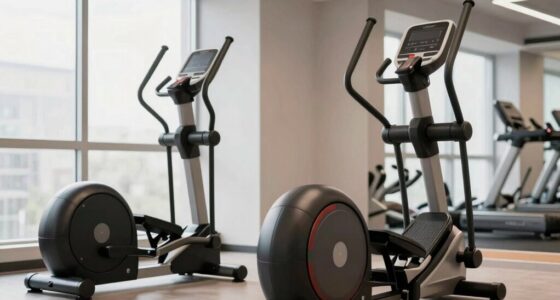
If you’re after accurate and reliable heart rate data during intense workouts, chest strap monitors are the best choice because they measure electrical signals directly from your heart. Wrist sensors are more convenient and comfortable, ideal for casual workouts or daily activity tracking. They are easier to wear and sync wirelessly, but may be less precise during vigorous exercise. To discover which option suits your needs best, explore further to find out more about their strengths and limitations.

Get workout gear delivered free with Prime
- Fast, free delivery on millions of items
- Prime Video, Amazon Music and more included
- Member-only deals all year
Key Takeaways
- Chest straps offer higher accuracy and reliability during vigorous exercise due to direct electrical signal measurement.
- Wrist sensors provide greater convenience, are easier to wear, and sync quickly with devices for casual use.
- Chest straps generally have longer battery life, making them suitable for extended workouts; wrist sensors require more frequent recharging.
- Wrist sensors may be affected by movement or skin tone, impacting data consistency, while chest straps maintain accuracy during intense activity.
- Both devices support wireless connectivity, but chest straps excel for serious athletes needing precise real-time heart rate data.
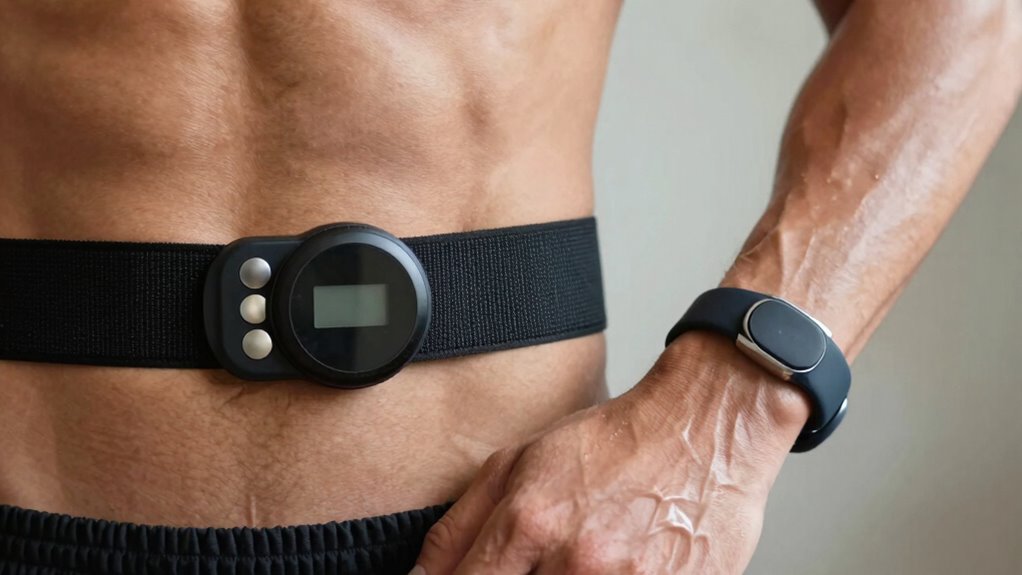
When choosing a heart rate monitor, you might find yourself torn between chest strap monitors and wrist sensors, each offering different advantages. Your decision depends on your priorities, whether it’s accuracy, convenience, or features like wireless connectivity. Chest strap monitors are often praised for their precision because they directly measure electrical signals from your heart. They typically have longer battery life, so you don’t have to worry about frequent recharges during extended workouts. Many models also come equipped with advanced wireless connectivity options like Bluetooth and ANT+, allowing seamless pairing with fitness apps, smartwatches, or gym equipment. This makes it easy to track your heart rate in real time and analyze data afterward, especially if you want detailed insights into your training. Since chest straps are worn snugly around your chest, they tend to deliver consistent readings even during intense or high-movement activities, making them ideal for serious athletes or those who prioritize accuracy over ease of use. Additionally, chest strap monitors often utilize electrical signal measurement, which enhances their reliability during vigorous exercise. Their ability to provide accurate data during high-intensity workouts makes them the preferred choice for competitive athletes.
Moreover, advancements in sensor technology have contributed to their increased accuracy and reliability, even during dynamic movements. These improvements are partly due to the development of more sophisticated biometric sensors that can better adapt to various skin tones and movement patterns, ensuring dependable readings across diverse users. Furthermore, the robustness of signal processing algorithms in newer models helps filter out noise caused by excessive motion, further improving data quality.
On the other hand, wrist sensors, often integrated into fitness trackers or smartwatches, focus on convenience. They’re lightweight, comfortable, and easy to put on or take off, which appeals to casual exercisers or those who prefer minimal gear. Wireless connectivity is also a feature here, allowing quick sync with your smartphone or other devices, so you can view your heart rate data instantly. However, wrist sensors typically have shorter battery life compared to chest straps because their optical sensors require more power to continuously monitor blood flow through your wrist. This means you might need to charge them more frequently, especially if you use them regularly or for extended periods. While they’re generally accurate enough for moderate exercise, their readings can sometimes be affected by movement, skin tone, or placement, which can lead to less reliable data during high-intensity workouts. Still, many models have improved over the years, providing satisfactory accuracy for most fitness routines.
Ultimately, your choice boils down to what you value most. If you want precision, longer battery life, and reliable performance during intense workouts, a chest strap monitor is likely your best bet. But if you favor comfort, ease of use, and quick access to heart rate data without extra gear, a wrist sensor might suit you better. Both types offer wireless connectivity, making data transfer seamless, but keep in mind the trade-offs in battery life and accuracy. Whichever you choose, understanding these differences helps you get the most out of your fitness journey.
best chest strap heart rate monitor
As an affiliate, we earn on qualifying purchases.
As an affiliate, we earn on qualifying purchases.
Frequently Asked Questions
How Do These Devices Perform in Extreme Weather Conditions?
In extreme weather, your chest strap heart rate monitor usually performs better in weather resilience, as it’s less affected by temperature sensitivity. However, in very cold conditions, the strap might feel uncomfortable or lose contact, while hot or humid weather can cause sweat to interfere. Wrist sensors are more exposed to the elements, so they may struggle with accuracy in extreme heat or cold. Overall, chest straps tend to be more reliable in harsh conditions.
Are There Differences in Battery Life Between the Two Types?
Battery life varies like a rollercoaster ride between these devices. Chest strap monitors typically have longer battery longevity because they have lower power consumption, often lasting weeks on a single charge or battery. Wrist sensors, however, tend to drain batteries faster due to continuous display and Bluetooth use, needing more frequent recharging or battery replacement. So, if longevity matters, chest straps might be your better bet for extended use.
Can These Monitors Track Heart Rate Variability?
Yes, both chest strap monitors and wrist sensors can track heart rate variability (HRV), but their accuracy varies. Chest straps generally offer better sensor sensitivity and heart rate consistency, providing more precise HRV readings. Wrist sensors may sometimes struggle with sensor sensitivity, especially during intense movements, which can affect HRV accuracy. If you’re serious about HRV tracking, a chest strap is usually the better choice for reliable data.
Which Device Is More Suitable for Swimming?
For swimming, wrist sensors are more suitable because they offer better water resistance and durability. Did you know that most wrist devices are designed to withstand depths of up to 50 meters? They’re convenient and comfortable, making them ideal for swimming sessions. Chest straps, on the other hand, often struggle with water resistance and may not stay secure during vigorous movements, limiting their effectiveness in aquatic environments.
Do They Require Calibration for Accuracy?
You don’t usually need to calibrate either device for accuracy, but device durability and user comfort matter. Chest straps tend to be more accurate because they directly measure your heartbeat, but they might feel less comfortable during long swims or workouts. Wrist sensors are more convenient and comfortable, especially for swimming, but they may require occasional calibration or repositioning to maintain accuracy. Choose based on your comfort and the device’s durability in water.
wireless wrist heart rate sensor
As an affiliate, we earn on qualifying purchases.
As an affiliate, we earn on qualifying purchases.
Conclusion
Choosing between chest strap monitors and wrist sensors is like picking between a loyal racehorse and a swift butterfly—each has its own charm. The chest strap offers unwavering accuracy, like a steady lighthouse guiding your fitness journey, while wrist sensors are the quick, effortless butterflies fluttering along your wrist. Decide what suits your style and goals. Whichever you choose, let your heart lead the way, beating out the rhythm of your active life.
accurate heart rate monitor for intense workouts
As an affiliate, we earn on qualifying purchases.
As an affiliate, we earn on qualifying purchases.
fitness tracker with heart rate monitor
As an affiliate, we earn on qualifying purchases.
As an affiliate, we earn on qualifying purchases.
Halloween Picks
halloween
As an affiliate, we earn on qualifying purchases.