
Choosing adjustable dumbbells for a home gym often comes down to a practical tradeoff: do you want quick, familiar weight changes, or a compact system that can grow heavier and tolerate years of hard use? The Nuobell 5–80 lb and PowerBlock Elite USA 5–90 lb address those priorities differently. Nuobell’s twist selector and conventional shape make circuit training and familiar dumbbell movements feel straightforward. PowerBlock’s block-shaped design takes up little floor space, and compatible expansion kits can raise its capacity beyond the base set.

Get workout gear delivered free with Prime
- Fast, free delivery on millions of items
- Prime Video, Amazon Music and more included
- Member-only deals all year

Adjustable Dumbbells Set, Pair, 5–52.5 lb Each
- ✔ Set: Pair of 2 dumbbells
- ✔ Weight per dumbbell: 5–52.5 lb
- ✔ Combined maximum: 105 lb
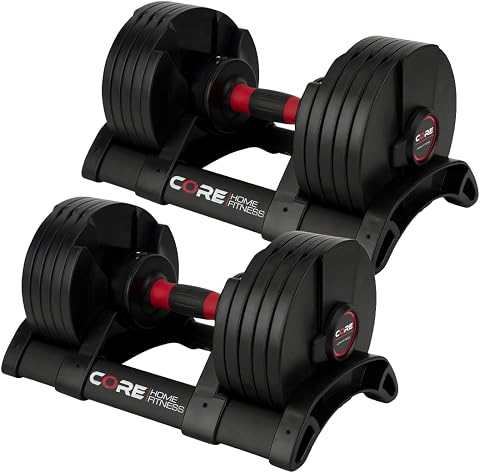
Core Fitness Adjustable Dumbbell Set, 5–50 lb Each
- ✔ Set: 2 adjustable dumbbells
- ✔ Weight range: 5–50 lb each
- ✔ Adjustment: TwistLock technology

MouldBody Adjustable Dumbbell Set Pair (25 lb or 50 lb) – 10-in-1 Free Weights
- ✔ Set: Pair of 2 dumbbells
- ✔ Weight options: 3, 5, 8, 10, 13, 15, 18, 20, 23, 25 lb
- ✔ Maximum per dumbbell: 25 lb
That difference matters more than a small gap in listed maximum weight. Choose Nuobell if smooth weight changes and a traditional grip are central to your workouts. Choose PowerBlock if you lift heavy, expect your strength to increase, or value a compact system that can be expanded. Both cost more than basic fixed-weight pairs, so the right buy depends on whether their space savings and flexibility will replace enough separate dumbbells to justify the premium.
At a Glance
| Criteria | Nuobell 5–80 lb Adjustable Dumbbells | PowerBlock Elite USA 5–90 lb Adjustable Dumbbells | Winner |
|---|---|---|---|
| Weight range and expansion | 5–80 lb per dumbbell; no comparable expansion path for this model | 5–90 lb per dumbbell in the base set; compatible expansion kits can raise capacity | B |
| Weight-change speed | Twist handle to select a load; fast between sets | Selector pin and handle adjustment; straightforward, with more steps than a twist selector | A |
| Grip and exercise feel | Round, familiar dumbbell shape with a knurled handle | Block-shaped profile with an enclosed hand grip; feels less like a conventional dumbbell | A |
| Storage footprint | Compact cradle-based pair, though the handles need clearance | Very compact, stackable block form; little floor space required | B |
| Durability and handling | Precision selector mechanism; best treated as a delicate adjustable system | Steel construction and simple adjustment parts suit regular home use; avoid dropping | B |
| Price and long-term value | Premium upfront cost; strong convenience value for frequent weight changes | Premium but expandable; added capacity may defer a heavier replacement | Depends |
Adjustable Dumbbells Set, Pair, 5–52.5 lb Each
For a home gym where one pair needs to cover both moderate and more demanding work, this set has the broadest stated ceiling in our comparison: 52.5 pounds per dumbbell. Its 15 settings start at 5 pounds and include smaller 2.5-pound steps through much of the lower and middle range. Those increments can make it easier to progress gradually than a set with fewer choices, while the higher end gives it more headroom than MouldBody’s 25-pound maximum.Changing weight means rotating the handle while the dumbbell sits on its nylon base. That keeps the process contained and avoids adding or removing plates by hand, but it also means we need to return each dumbbell to its base before the next change. The double auto-locking design is intended to secure plates when lifted; buyers should still follow the supplied operating instructions and make sure the mechanism is set correctly. At 17 inches long, it is larger than Core Fitness’s listed 14.5-inch model, so it is not the most compact option in this group.Rubber-wrapped grips and a nylon base are practical touches for regular indoor use, with the base designed to protect floors. Compared with Core Fitness, this pair offers a slightly higher maximum and more specified weight settings, while Core is shorter and lists a narrower handle diameter. The tradeoff is a 4-inch handle diameter and the need to keep the bases accessible. We’d choose it for range and progression; buyers who lift beyond 52.5 pounds per hand or need a slim storage footprint should look elsewhere.
Pros:
- 15 settings per dumbbell from 5 to 52.5 lb
- Handle rotation changes weight without manual plate swapping
- Double auto-locking design is intended to secure plates when lifted
- Rubber-wrapped grips and nylon bases suit indoor home use
Cons:
- Weight changes require setting the dumbbell on its base
- 17-inch length and 4-inch handle diameter may feel bulky to some users
- The 52.5 lb maximum may not cover advanced strength goals
Best for: Home lifters who want a pair with many weight choices and the highest per-dumbbell maximum in this comparison.
Not ideal for: Lifters who need more than 52.5 lb per hand, want to change weights away from a base, or have very limited storage space.
Bottom line: We rank this first for its broadest range and highest capacity, provided its docked adjustment and larger handle suit your home setup.
“We rank this first for its broadest range and highest capacity, provided its docked adjustment and larger handle suit your home setup.”
Core Fitness Adjustable Dumbbell Set, 5–50 lb Each
Core Fitness is the most space-conscious choice among the sets with a near-50-pound maximum. Each dumbbell adjusts from 5 to 50 pounds, only 2.5 pounds below the top pick, and the listed length is 14.5 inches. That shorter footprint may make storage easier beside a bench or under a home gym shelf. Its TwistLock system changes weight with one hand while the dumbbell rests in its cradle, giving it a simple routine for moving between exercises.The cradle requirement is a meaningful constraint: the quick adjustment happens at the dock, not while holding the dumbbell. This is similar to the first-ranked set, though the mechanisms differ—Core uses TwistLock, while the other uses handle rotation. Core’s contoured, textured soft-grip handle and 1.25-inch diameter also make the grip profile more specifically described than the wider 4-inch diameter listed for the top pick. Buyers should consider how that handle shape feels and whether it suits their grip preferences.Compared with MouldBody, Core offers twice the stated top-end weight per dumbbell, so it leaves more room for strength progression but may be more than a beginner needs. The product details list aluminum and composite materials and a two-year warranty. Its maximum remains below the top-ranked set, and the supplied specifications do not state the number of available weight settings. We see it as the compact middle ground: choose it when storage and a near-50-pound range matter, but skip it if you need more capacity or want a clearly specified full set of increments.
Pros:
- 5–50 lb range per dumbbell supports a broad range of home exercises
- TwistLock enables one-hand adjustment while docked
- 14.5-inch listed length supports more compact storage
- Contoured textured grip and two-year warranty are specified
Cons:
- Weight changes require the included cradle
- Maximum is below the top-ranked set’s 52.5 lb per dumbbell
- The supplied specifications do not state the number of weight settings
Best for: Home gym owners who want a compact pair with one-hand adjustment and a maximum near 50 lb per dumbbell.
Not ideal for: Buyers who need the highest available capacity, want to adjust without a cradle, or prioritize a stated count of weight settings.
Bottom line: We recommend Core Fitness when compact dimensions and straightforward docked adjustment matter more than having the highest maximum in the lineup.
“We recommend Core Fitness when compact dimensions and straightforward docked adjustment matter more than having the highest maximum in the lineup.”
MouldBody Adjustable Dumbbell Set Pair (25 lb or 50 lb) – 10-in-1 Free Weights
MouldBody takes a different approach from the two heavier sets: each dumbbell tops out at 25 pounds, with ten settings from 3 to 25 pounds. That makes it the most approachable option here for lighter routines, early strength training, or exercises where small hand weights are sufficient. The 3-pound starting point is also lower than the 5-pound minimums of the other pairs. For buyers whose planned workouts stay within this range, the set can replace several individual weights without requiring a large rack.Its one-hand dial system is designed for quick weight changes, and an included storage tray keeps the pair together when not in use. As with the other options, we need to dock the dumbbell and ensure the plates are aligned and locked before lifting. The product description specifically advises careful alignment and audible confirmation. That extra check is worth building into the routine; a quick adjustment is useful only when the mechanism is engaged correctly.Compared with Core Fitness and the 52.5-pound set, MouldBody sacrifices substantial upper-end capacity. It is therefore less suitable for lifters who expect to progress to heavier presses, rows, or lower-body movements with dumbbells. In return, it offers a lower starting weight, ten clear options, and a tray for organization. This is the sensible entry point for lighter training, not the best long-term pick for someone already lifting near the other sets’ upper ranges. Its item weight is listed as 25 pounds, but the supplied details do not clarify whether that figure applies to one dumbbell or the pair, so we do not use it to compare total set weight.
Pros:
- Ten settings from 3 to 25 lb per dumbbell
- One-hand dial system is designed for quick changes
- Includes a tray for organized storage
- Steel plates and a secure locking mechanism are specified
Cons:
- 25 lb maximum per dumbbell is the lowest in this comparison
- Requires careful plate alignment and audible locking confirmation
- Supplied details do not clarify whether the 25 lb item weight refers to one dumbbell or the pair
Best for: Beginners and home exercisers whose workouts call for weights between 3 and 25 lb per hand and who value an included tray.
Not ideal for: Intermediate or advanced lifters who need more than 25 lb per hand or want greater headroom for strength progression.
Bottom line: We place MouldBody third because it is a capable lighter-training set with convenient storage, but its 25-pound ceiling narrows its usefulness as strength demands grow.
“We place MouldBody third because it is a capable lighter-training set with convenient storage, but its 25-pound ceiling narrows its usefulness as strength demands grow.”
As an Amazon Associate we earn from qualifying purchases.
Key Differences
The most noticeable everyday difference is how the dumbbells feel and change between exercises. Nuobell’s round form and twist selector preserve much of the familiar experience of picking up a fixed dumbbell, and a quick adjustment helps when a workout alternates between movements. PowerBlock trades that conventional feel for a block profile and a pin-based selection system. The adjustment takes a little more attention, but the compact shape makes storage easy and the base set reaches 90 lb.
Capacity and durability favor PowerBlock for lifters who expect to progress beyond moderate weights or want expansion options. Nuobell’s 80 lb ceiling covers a wide range of home strength training, but does not offer the same path to higher loads. Both require sensible handling: adjustable mechanisms are not meant to be dropped like many commercial fixed dumbbells. On value, Nuobell earns its cost through speed and familiar handling, while PowerBlock earns its cost through compact storage, rugged construction, and the possibility of buying more capacity later.
Detailed Comparison
Weight range and expansion (PowerBlock Elite USA 5–90 lb Adjustable Dumbbells wins — moderate)
PowerBlock wins by a moderate margin for strength progression. Its Elite USA base set reaches 90 lb per dumbbell, compared with Nuobell’s 80 lb, and compatible expansion kits can extend its ceiling further. For beginners and many general fitness routines, both ranges are ample. The difference becomes meaningful for strong lifters, especially on rows, presses, and lower-body movements where dumbbell loads can rise quickly. Choose Nuobell if 80 lb per hand is comfortably beyond your foreseeable needs; choose PowerBlock if you want a route to heavier training without replacing the whole system.
Weight-change speed (Nuobell 5–80 lb Adjustable Dumbbells wins — moderate)
Nuobell wins, with a moderate practical advantage for workouts that change loads often. Its twist selector makes weight changes quick and intuitive. PowerBlock’s selector pin and adjustment process are simple once learned, but take more handling between settings. For straight sets with long rests, this is a minor inconvenience. In supersets, circuits, or shared home workouts where two people use different loads, Nuobell’s quicker changes can keep the session moving.
Grip and exercise feel (Nuobell 5–80 lb Adjustable Dumbbells wins — moderate)
Nuobell wins for a familiar dumbbell feel. Its round profile and conventional handle suit curls, presses, and other movements where users expect a standard dumbbell shape. PowerBlock’s enclosed grip and rectangular ends can feel unusual at first, particularly during movements where the dumbbell rests against the body or rotates close to the wrist. Many exercises work well with either system, so this gap is moderate rather than decisive. If conventional handling is a high priority, Nuobell is the easier adjustment; if compactness matters more, PowerBlock’s shape is a reasonable trade.
Storage footprint (PowerBlock Elite USA 5–90 lb Adjustable Dumbbells wins — moderate)
PowerBlock wins by a moderate margin if floor space is scarce. Its block form stores neatly and uses very little room, which suits apartment corners, small spare rooms, or a gym shared with other household uses. Nuobell also replaces a rack of fixed dumbbells with a compact pair and cradles, but the traditional handles and cradles need some clearance. For most home gyms, both are far more space-efficient than a full dumbbell rack; the difference matters most when every inch counts.
Durability and handling (PowerBlock Elite USA 5–90 lb Adjustable Dumbbells wins — moderate)
PowerBlock wins for a small but meaningful durability edge. Its steel construction and straightforward pin system are designed for regular use, while Nuobell’s selector mechanism rewards careful placement and handling. Neither set should be dropped, and a user who treats adjustable dumbbells like commercial fixed weights risks damage regardless of brand. For controlled home training, both can serve well. If equipment is shared by less careful users or sees frequent daily sessions, PowerBlock’s simpler, rugged design is the safer choice.
Price and long-term value (major difference)
There is no universal winner because each system saves money in a different way. Nuobell is worth its premium for people who regularly change loads and want a conventional dumbbell experience without buying many pairs. PowerBlock can offer stronger long-term value for lifters who will use its expansion options: buying a compatible kit may cost less than replacing a set that has reached its limit. If you rarely adjust weights and have room for fixed dumbbells, neither premium may pay off. Compare current set and expansion prices before buying, since bundles and retailer offers change the calculation.
Nuobell 5–80 lb Adjustable Dumbbells: Pros and Cons
Pros:
- Fast twist-selector weight changes suit circuits and supersets.
- Traditional round shape and handle feel familiar.
- Wide 5–80 lb range covers most home strength routines.
- Compact pair replaces many individual dumbbells.
Cons:
- Maximum load is lower than PowerBlock’s base set.
- No equivalent expansion path for this model.
- Selector mechanism calls for careful handling and should not be dropped.
- Premium price may be hard to justify for infrequent weight changes.
PowerBlock Elite USA 5–90 lb Adjustable Dumbbells: Pros and Cons
Pros:
- Base set reaches 90 lb per dumbbell.
- Compatible expansion kits provide a path to greater capacity.
- Compact block shape stores neatly in a small home gym.
- Robust construction and a straightforward pin system suit regular use.
Cons:
- Block shape feels less like a conventional dumbbell.
- Changing weight takes more steps than Nuobell’s twist selector.
- Higher loads require compatible expansion purchases.
- Like other adjustable dumbbells, it should not be dropped.
Who Should Choose What
Choose Nuobell 5–80 lb Adjustable Dumbbells if:
- You change weights often during circuits, supersets, or shared workouts.
- You prefer a round dumbbell shape and familiar handle position.
- An 80 lb maximum per hand is enough for your current and expected training.
Choose PowerBlock Elite USA 5–90 lb Adjustable Dumbbells if:
- You lift heavy or want the option to expand beyond 90 lb per hand.
- Your training space is small and compact storage is a priority.
- You value rugged construction and can accept a less conventional feel.
Skip both if: You have room for fixed dumbbells, rarely change loads, or expect to drop your weights; fixed pairs or a purpose-built heavy-duty system may suit those needs better.
Value for Money
Pay more for Nuobell if quick changes and familiar handling will make you use the set more often or keep workouts flowing. Its value is convenience, especially for circuits and households where multiple people train at different loads. Pay more for PowerBlock if you will use its compact storage and expansion capacity. The option to add weight later can make the initial purchase last longer, though expansion kits add to the total cost.
For a typical home lifter who trains with controlled reps and does not need loads above 80 lb, Nuobell’s convenience may be worth the premium. For a serious lifter with limited space or a clear progression toward heavier loads, PowerBlock is the stronger long-term value. If budget matters most and weight changes are infrequent, compare the total cost of either system with buying only the fixed pairs you actually use.
Final Verdict
For most buyers choosing between these two premium systems, the deciding question is whether convenience or progression matters more. Choose Nuobell if you want fast adjustments and the closest feel to traditional dumbbells, and your training does not require more than 80 lb per hand. Choose PowerBlock Elite USA if you lift heavy, need compact storage, or want to expand capacity later. Its shape takes some getting used to, but the extra load range and expansion path make it the better pick for strength-focused home gyms. If neither fast changes nor adjustable capacity will solve a real space or budget problem, buy the fixed weights you need instead.
Frequently Asked Questions
Which adjustable dumbbells are better for beginners?
Either can work for beginners. Nuobell is easier to use if quick, intuitive adjustments matter. PowerBlock is a better fit if the beginner expects to progress toward heavy lifting and wants an expansion path. Both ranges exceed what many people need when starting out.
Can you drop Nuobell or PowerBlock dumbbells?
Neither is designed to be dropped like a fixed commercial dumbbell. Impact can damage adjustable components or disrupt their alignment. Set them down under control and follow the manufacturer’s handling guidance.
Is PowerBlock’s higher weight capacity worth choosing over Nuobell?
It is worth paying for if your strength training already uses heavy dumbbells or you expect to outgrow 80 lb per hand. If your routines are likely to stay below that ceiling, Nuobell’s faster adjustments and familiar grip may matter more in everyday use.
Are adjustable dumbbells better value than fixed dumbbells?
They are better value when one compact set replaces many pairs and you will use several weight settings. Fixed dumbbells can cost less if you need only a few weights, have room to store them, or train in a way that puts adjustable mechanisms at risk.