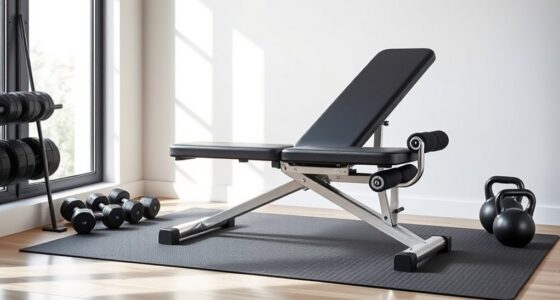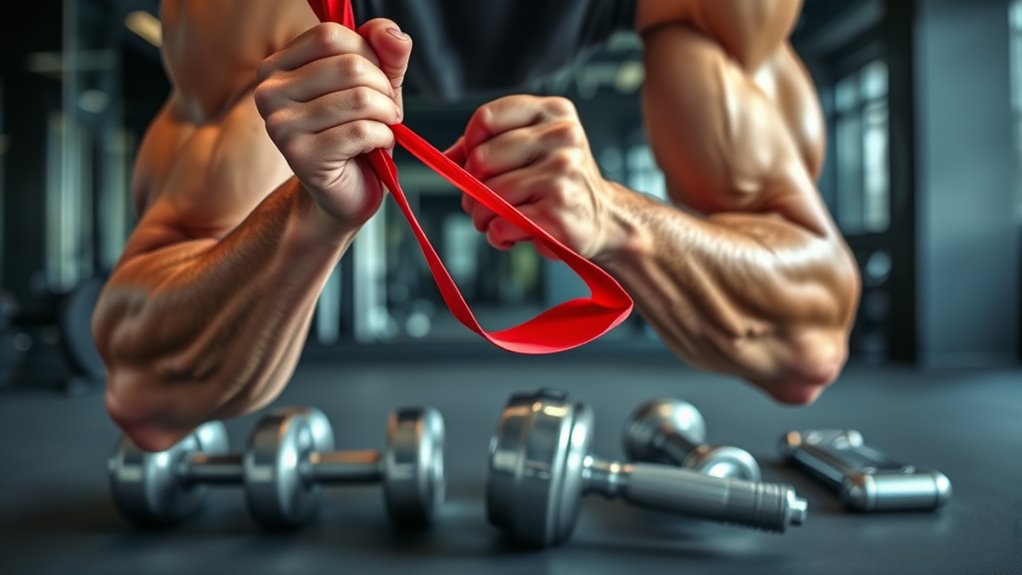

Yes, resistance bands can build muscle just like free weights by providing consistent tension, allowing you to target specific muscles with precision. They enable controlled movement, promote proper form, and support progressive overload as you increase resistance. Plus, bands are versatile, portable, and ideal for varied workouts, making them effective for muscle growth, especially for beginners or during rehab. Keep exploring to discover how bands can complement or even replace traditional weights in your routine.
Key Takeaways
- Both resistance bands and free weights can stimulate muscle growth when used correctly.
- Resistance bands offer constant tension and variable resistance, promoting effective muscle engagement.
- Free weights are traditionally effective for building muscle mass through heavier lifting.
- Bands excel in muscle isolation, targeting specific muscles with controlled movements.
- Combining both tools can optimize muscle development and training versatility.

When choosing between resistance bands and free weights, understanding their differences can help you make the best decision for your fitness goals. Resistance bands offer unique benefits that can complement your workout routine, especially when it comes to muscle isolation and workout versatility. Unlike free weights, which rely on gravity and fixed weights, bands provide constant tension throughout the movement, allowing you to target muscles more precisely. This makes them excellent for isolating specific muscle groups, helping you focus on form and activation. If you’re aiming to strengthen particular muscles or refine your technique, resistance bands can be invaluable. They’re also highly versatile, fitting into many different exercises, whether you’re doing upper body presses, leg extensions, or core work. Because bands come in various resistance levels, you can easily modify the intensity to match your strength and progress over time.
Furthermore, resistance bands enable a broader range of motion compared to free weights, which can sometimes be limited by the weight’s path of travel. This increased range allows for more natural movement patterns, reducing joint strain and enhancing muscle engagement. You can incorporate bands into nearly any workout, from warm-ups to advanced strength training, making them a flexible addition to your fitness arsenal. They’re also portable, so you can perform effective workouts anywhere—whether at home, in the gym, or while traveling—without needing bulky equipment or access to a gym. This convenience encourages consistency, which is essential for muscle development and overall fitness. Additionally, resistance bands can be used to simulate the variable resistance found in certain UST projectors and ALR screens, proving their adaptability beyond traditional strength training.
While free weights are traditionally seen as the gold standard for muscle building, resistance bands can effectively build muscle too, especially when used correctly. They provide resistance throughout the entire exercise, creating a constant challenge for your muscles. This continuous tension can stimulate growth just as well as free weights, particularly for beginners or those focusing on rehabilitation. Additionally, bands allow for more controlled, slow movements, which can help maximize muscle engagement and reduce injury risk. They’re also excellent for adding resistance to bodyweight exercises or for progressive overload when weights become too easy.
Frequently Asked Questions
Can Resistance Bands Replace Free Weights Entirely?
Yes, resistance bands can replace free weights for muscle isolation and versatility, especially if you prefer a portable option. They’re great for targeting specific muscles and offer a convenient way to work out anywhere. While they might not fully replace free weights for building maximum strength, they provide effective resistance training with portability benefits, making them a practical choice for many fitness routines.
Are Bands Safer for Beginners Than Free Weights?
Yes, resistance bands are generally safer for beginners because they offer better safety considerations and beginner accessibility. You’re less likely to hurt yourself with bands since they provide controlled resistance and reduce the risk of dropping heavy weights. Plus, bands are easy to use at home or in small spaces, making them an excellent choice as you learn proper form and build confidence without the intimidation of free weights.
How Do Bands Compare for Building Maximum Strength?
You can build impressive strength with resistance bands, but they may not match free weights for maximum gains. Studies show free weights allow for greater progression strategies, increasing load gradually to stimulate muscle activation more effectively. Bands excel in maintaining tension and targeting stabilizer muscles, but for pure strength development, incorporating free weights is essential for progressive overload and reaching peak muscle activation.
Can Bands Improve Muscle Endurance Better Than Free Weights?
Yes, resistance bands can improve muscle endurance better than free weights because they promote muscle hypertrophy through constant tension and offer greater training versatility. When you use bands, you’re engaging stabilizer muscles and maintaining tension throughout the movement, which enhances endurance. Plus, their versatility allows you to perform a wide variety of exercises, helping you challenge your muscles in new ways and build stamina over time.
Are There Any Muscles That Bands Cannot Target Effectively?
Bands have limitations when it comes to targeting certain muscles, especially smaller or deep stabilizers. They may struggle to provide the resistance needed for heavy compound lifts like deadlifts or squats, making it harder to fully target large muscle groups like the glutes and hamstrings. While excellent for many muscles, you might find bands less effective for building maximum strength in some target muscle groups compared to free weights.
Conclusion
So, whether you’re using resistance bands or free weights, you can definitely build muscle—studies show bands can provide up to 80% of the muscle activation compared to free weights. That means you don’t need heavy equipment to see gains. Both options have their perks, so why not mix them up? You’ll stay challenged, prevent plateaus, and keep your workouts fresh. Ultimately, consistency is key—choose what works best for your goals and keep pushing forward!