
TL;DR

Get workout gear delivered free with Prime
- Fast, free delivery on millions of items
- Prime Video, Amazon Music and more included
- Member-only deals all year
Researchers reported that a sphingolipid measured in exhaled breath condensate distinguished idiopathic pulmonary fibrosis from fibrotic hypersensitivity pneumonitis in a small study. The result is preliminary: breath samples were available from 49 patients, and independent validation is needed before the approach can be considered for clinical use.
Researchers reported that a lipid measured in exhaled breath condensate may help distinguish idiopathic pulmonary fibrosis (IPF) from fibrotic hypersensitivity pneumonitis, two lung conditions that can be difficult to tell apart in advanced disease. In the study presented at the CHEST meeting in Phoenix, sphingomyelin C24:0 predicted the diagnosis correctly in 80% of fibrotic hypersensitivity pneumonitis cases and 85.7% of IPF cases among the patients who provided breath samples; the findings are preliminary and require outside validation.
The breath-test result had an area under the receiver operating characteristic curve (AUC) of 0.897, a measure of how well a test separates groups across possible thresholds. A blood measurement of plasma dihydrosphingosine had more modest predictive performance on its own, with an AUC of 0.737. Combining the blood marker with the breath marker produced an AUC of 0.906, only a small increase over the breath result alone, according to the study findings reported by MedPage Today.
The study included 101 people who provided blood samples: 28 healthy controls, 33 people with IPF and 40 with fibrotic hypersensitivity pneumonitis. Breath condensate was collected from a smaller subset: 10 controls, 21 people with IPF and 18 with fibrotic hypersensitivity pneumonitis. That distinction matters because the headline accuracy figures come from the limited breath-sample group, not all 101 participants.
Jon Mullholand, MD, of Virginia Commonwealth University, presented the findings at the meeting hosted by the American College of Chest Physicians. The samples were analyzed for sphingolipids, a class of lipids involved in processes including inflammation and fibrosis. The report does not establish that the test can replace existing diagnostic workups or improve patient outcomes.
A Potential Aid When Scans Overlap
IPF and fibrotic hypersensitivity pneumonitis can share clinical, imaging and even pathological features, particularly in advanced disease. Mullholand said distinguishing the conditions matters because their management and prognosis differ. A diagnostic error could lead clinicians toward an unsuitable treatment approach; he said that could affect outcomes and potentially mortality.
A breath-based marker could eventually add information to a diagnostic process that may be difficult when standard evidence points in more than one direction. But the study shows predictive performance in a research sample, not proof that using the test changes decisions or benefits patients. Clinicians would need to assess it alongside symptoms, exposure history, imaging and other established evidence.
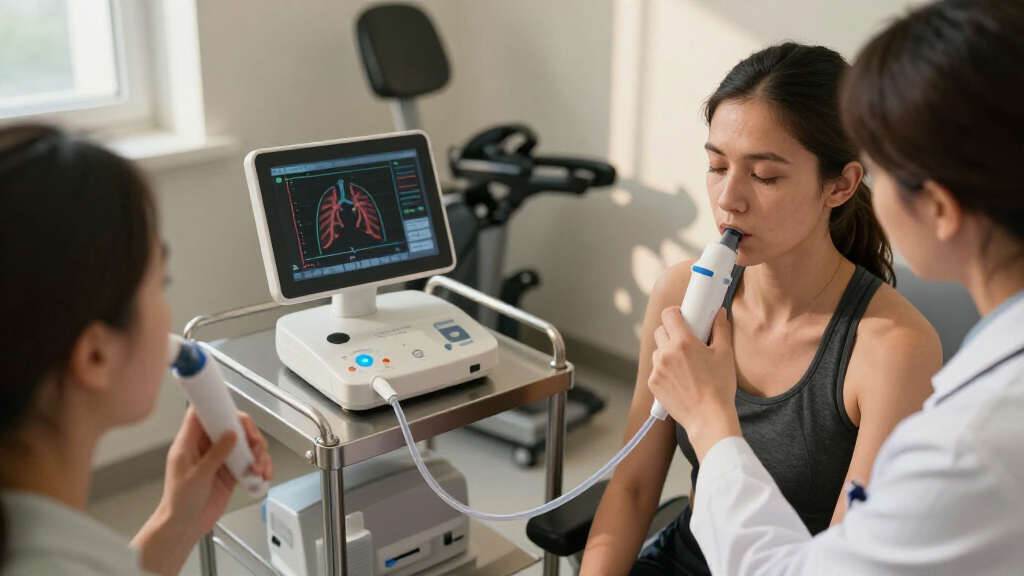
exhaled breath condensate collection device
As an affiliate, we earn on qualifying purchases.
As an affiliate, we earn on qualifying purchases.
How Breath Samples Were Collected
Exhaled breath condensate is collected by directing a person’s breath through a device where cooling causes moisture to condense into a sample. Mullholand described a collection tube similar to an inhaler, with a refrigerant used to produce liquid for analysis. The approach is intended to sample substances from the lungs, offering a different view from blood tests that reflect changes across the body.
According to Mullholand, sphingolipids have been linked to inflammation and fibrosis, and earlier research found altered sphingolipid patterns in IPF. In this study, the breath samples from people with IPF looked similar to those from controls, while samples from people with fibrotic hypersensitivity pneumonitis showed greater increases in the measured lipids, he reported. He suggested this might reflect differences between a more local pulmonary inflammatory process and a disease with broader systemic features; that interpretation remains a possible explanation, not an established mechanism.
The method also has practical limits. Mullholand said collecting a breath-condensate sample can take 15 to 20 minutes, which may be difficult for people with severe lung disease. He also described the assay as technically challenging and said breath-condensate testing is not accepted for analysis by many U.S. laboratories. Plasma sphingolipid testing is not a common assay either.
“There’s a diagnostic challenge when we’re trying to differentiate these [two conditions] at end-stage disease, as they can have overlapping clinical presentations as well as imaging features, even pathologic slides.”
— Jon Mullholand, MD, Virginia Commonwealth University, speaking at the CHEST meeting
As an affiliate, we earn on qualifying purchases.
Validation and Practical Limits
The findings have not yet been confirmed in an external validation study, which Mullholand said would be needed before the results could support a move toward clinical practice. The number of people who supplied breath samples was relatively small, and the report does not provide enough detail to determine how the test would perform across broader patient populations or at different stages of disease.
It is also unclear what threshold would be used in practice, how the test would fit with current diagnostic methods, and whether the reported accuracy would hold in laboratories using different collection and analysis procedures. The AUC describes performance across thresholds; it does not by itself show how often a test would lead to a correct diagnosis in a particular clinic or whether it improves care. The study also did not show that the biomarker causes either condition or explain the biological differences behind the observed patterns.
As an affiliate, we earn on qualifying purchases.
Independent Testing Comes Next
The next key step is external validation in a separate group of patients, including assessment of whether breath samples can be collected and analyzed consistently. Researchers would also need to establish practical testing procedures and determine how results compare with the full diagnostic evaluation used for IPF and fibrotic hypersensitivity pneumonitis.
Mullholand said the lipid findings may also guide research into the disease process, including whether sphingolipids are part of a pathway that contributes to fibrosis or are a consequence of illness. No timeline for validation or clinical availability was provided in the report. For now, the breath test remains a research finding, not a routine diagnostic option.
As an affiliate, we earn on qualifying purchases.
Key Questions
What did the breath test measure?
Researchers measured sphingomyelin C24:0, a sphingolipid, in exhaled breath condensate, a liquid sample formed by cooling a person’s breath.
How accurate was the test in the study?
The study report said the marker correctly predicted fibrotic hypersensitivity pneumonitis in 80% of cases and IPF in 85.7% of cases among participants who supplied breath samples. The breath marker’s AUC was 0.897. These are preliminary results from a limited sample, not a guarantee of accuracy in routine care.
Could the test replace scans or other diagnostic tests?
The findings do not show that it can replace imaging, clinical assessment or other diagnostic methods. The test would need independent validation and evaluation as part of the wider diagnostic process.
When might the test be available to patients?
No availability date was reported. The researchers said external validation is needed, and breath-condensate analysis is not widely accepted by U.S. laboratories.
Source: rss
Halloween Picks
halloween
As an affiliate, we earn on qualifying purchases.