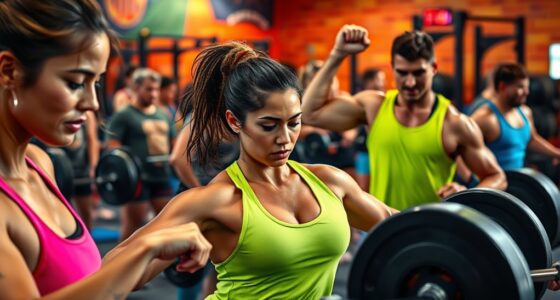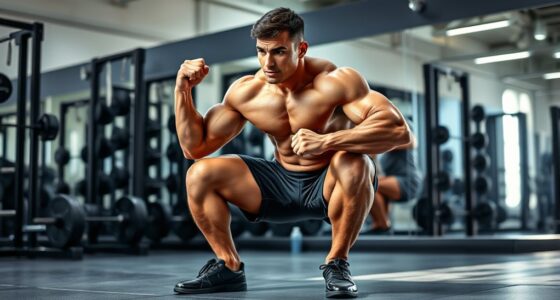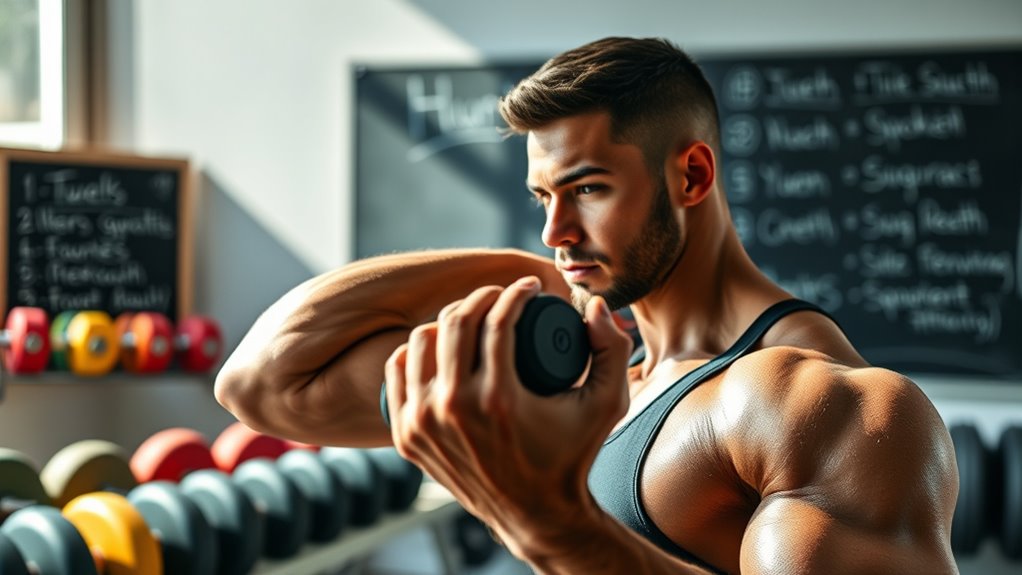

To tailor your workouts to your goals, focus on adjusting reps and sets accordingly. For strength, aim for 3-6 reps with heavier weights and 3-5 sets; for muscle growth, target 8-12 reps with 3-4 sets; and for endurance, go for 15+ reps with 2-3 sets. Increase weight, reps, or sets over time to keep challenging yourself. Exploring more ways to fine-tune your routine can help you maximize your progress.
Key Takeaways
- Adjust reps and sets based on your specific goal: lower reps with higher weights for strength, moderate reps for hypertrophy, and higher reps for endurance.
- Use 3-6 sets for strength training, 3-4 sets for muscle growth, and 2-3 sets for stamina to match your objectives.
- Gradually increase weight, reps, or sets over time to ensure continuous progression and prevent plateaus.
- Incorporate workout variation by changing exercises, reps, or sets to maintain effectiveness and avoid adaptation.
- Tailor your workout plan by systematically progressing and varying routines to align with your fitness goals and promote steady gains.

Have you ever wondered why generic workout plans often fall short of your goals? The truth is, following a one-size-fits-all routine rarely provides the steady progress you want. To truly see results, you need to focus on progression planning. This means adjusting your reps and sets over time to challenge your muscles and prevent plateaus. Without a clear plan for progression, your workouts can become monotonous, and your gains may stall. Incorporating progression planning ensures you’re continuously pushing your limits just enough to stimulate growth while avoiding injury or burnout.
Progression planning is key to continuous gains and avoiding workout stagnation.
But progression planning alone isn’t enough. Workout variation plays a vital role in keeping your training effective and engaging. When you stick to the same exercises, reps, and sets for too long, your body adapts, and progress slows down. To combat this, you should intentionally vary your workouts—change up your exercises, alter your rep ranges, or modify your set counts. This not only keeps your muscles guessing but also helps prevent boredom, making it easier to stay consistent. Additionally, understanding how muscle adaptation influences your training can help you develop smarter strategies for ongoing progress. By combining structured progression planning with purposeful workout variation, you create a dynamic training environment that promotes continuous improvement.
Now, when it comes to how many reps and sets you should do, it depends on your goals. If you’re aiming for strength, you’ll typically want to focus on lower reps—around 3 to 6 per set—with higher weights. Sets in this range usually total 3 to 5, allowing enough volume to build power without overtaxing your nervous system. If your goal is hypertrophy, or muscle size, you’ll want to target a moderate rep range—about 8 to 12 reps per set—with 3 to 4 sets. This rep range strikes a balance between mechanical tension and metabolic stress, key factors for muscle growth. For endurance, higher reps—15 or more per set—are effective, with 2 to 3 sets focusing on stamina.
While these guidelines are helpful, the real secret lies in adjusting them over time. As you progress, increase the weight, add more reps, or increase sets to challenge your muscles further. Remember, progression planning isn’t just about adding more reps or sets; it’s about systematically increasing the intensity to keep your body adapting. Coupled with workout variation, this approach ensures your training remains effective and aligned with your goals. So, instead of sticking to a rigid plan, listen to your body, make thoughtful adjustments, and keep your workouts fresh and challenging.
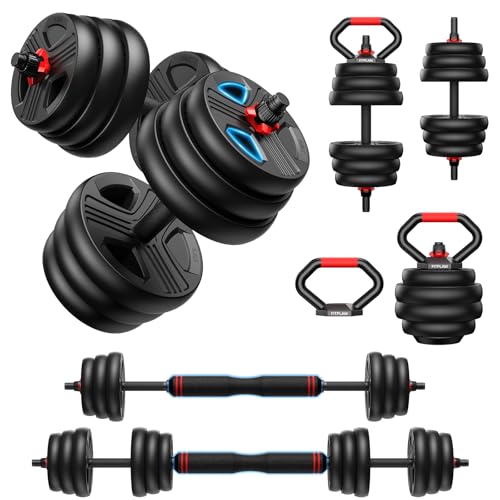
FDS1 Adjustable dumbbell set, 45lbs Free Weights set with upgraded nut, 5 in 1 Weight Set Used as Kettlebells, Barbell, Push up Stand, Fitness Exercise for Home Gym Suitable Men/Women
- Multifunctional 5-in-1 Design: Transforms into dumbbells, kettlebells, barbells, and more
- Dual-Lock Nut System: Red and black locks prevent weight shifting
- Adjustable Weight Options: Customize weights from light to heavy
As an affiliate, we earn on qualifying purchases.
As an affiliate, we earn on qualifying purchases.
Frequently Asked Questions
How Does Age Affect Optimal Reps and Sets?
As you age, age-related strength decline means you should focus on ideal rep ranges that promote muscle maintenance and recovery. Generally, lower reps with heavier weights help build strength, but as you get older, incorporating higher reps with moderate weights can prevent injury and improve endurance. Adjust your sets and reps based on your fitness level, listening to your body, and prioritizing consistency to maintain strength and overall health.
Can Beginners Safely Increase Reps Quickly?
Imagine climbing a steady hill—you wouldn’t sprint to the top right away. As a beginner, you can safely increase reps gradually, but quick jumps aren’t ideal. Focus on progression planning and adjusting workout frequency to avoid injury. Listen to your body and give yourself time to adapt. Incremental increases help build strength safely, ensuring you stay motivated and avoid burnout while progressing at a sustainable pace.
How Do I Adjust Reps for Injury Recovery?
When adjusting reps for injury recovery, start with low reps and focus on controlled, pain-free movements. Incorporate rehab exercises designed for injury prevention, gradually increasing reps as your strength and flexibility improve. Listen to your body, avoiding any discomfort or pain, and consult your healthcare provider for personalized guidance. This approach helps make certain of safe recovery while reducing the risk of re-injury and promoting effective healing.
What’s the Best Routine for Weight Loss?
For weight loss, focus on a routine that combines cardio benefits with strength training. Incorporate 3-5 sessions of moderate to high-intensity cardio weekly, like brisk walking or cycling. Pair this with resistance exercises to boost metabolism. Don’t forget nutrition timing: eat balanced meals before and after workouts to optimize fat burning and recovery. Consistency, combined with proper diet, helps you shed pounds effectively and sustainably.
How Do Reps Differ Between Strength and Endurance Goals?
Reps are like the gears of a machine, shifting based on your goal. For strength, you’ll do fewer reps—around 4 to 6—to promote muscle hypertrophy with heavier weights. For muscular endurance, you’ll crank up the reps—15 or more—using lighter weights to boost stamina. Adjusting reps helps you fine-tune your training, making sure your muscles grow stronger or last longer, depending on what you aim to achieve.

Resistance Bands for Working Out, 5-Pack Elastic Exercise Bands for Strength Training, Stretching, Workout; Home Gym Equipment for Women Men, Pilates Yoga Physical Therapy, Leg Glute Arm Exercise Kit
- Complete 5-Pack Fitness Kit: Includes 5 multi-level resistance bands
- Durable Natural Latex Material: Made from high-quality, stretchy latex rubber
- Versatile Full-Body Workout: Targets all major muscle groups effectively
As an affiliate, we earn on qualifying purchases.
As an affiliate, we earn on qualifying purchases.
Conclusion
By customizing your reps and sets, you turn your workout into a personalized journey, much like a tailor crafts a perfect suit. Whether you’re aiming for strength, endurance, or muscle growth, listen to your body and adjust accordingly. Consistency and variety keep things interesting, helping you stay motivated. Remember, progress is a marathon, not a sprint. Keep tweaking your routine, and you’ll see results unfold as smoothly as a well-fitted garment.
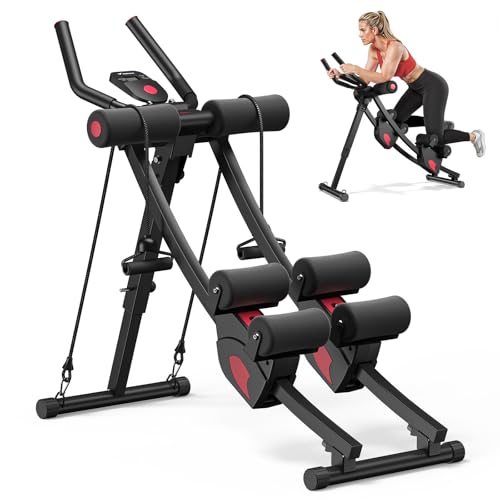
MERACH Ab Machine, Adjustable Ab Trainer Machine, AB Workout Equipment
- Multi-Function Ab Training: Targets waist, abs, and core
- Split-Track Design: Simulates mountain climbing for intensity
- Ergonomic Curved Track: 110° curve for natural movement
As an affiliate, we earn on qualifying purchases.
As an affiliate, we earn on qualifying purchases.

ATERCEL Workout Gloves for Men and Women, Exercise Gloves for Weight Lifting, Cycling, Gym, Training, Breathable and Snug fit (Black, L)
- Enhanced Grip Design: Maximizes grip and hand protection
- Breathable and Lightweight: Ensures comfort and flexibility during workouts
- Snug Fit with Multiple Sizes: Available in 5 sizes for a perfect fit
As an affiliate, we earn on qualifying purchases.
As an affiliate, we earn on qualifying purchases.