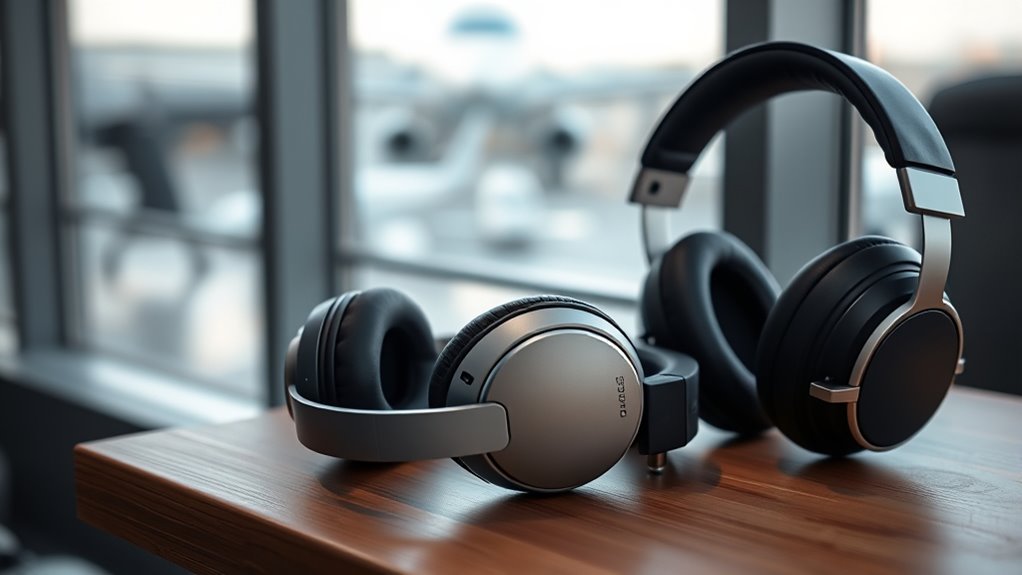

For flights and long commutes, I’d start with the TOZO HT3 for its foldable design, adaptive noise cancelling, and quick top-ups, or the Soundcore Q20i if a familiar app and multipoint listening matter more than maximum battery life. The KVIDIO Hybrid ANC is another strong fit for travelers who want long stated playback time and a wired option. These picks make different compromises: battery claims vary widely, bulky over-ear designs take space, and a noise-reduction figure alone does not predict how well headphones handle every cabin sound. I’ve ranked them around travel usefulness—noise control, power flexibility, comfort and portability—rather than treating the biggest number as an automatic win.

Get workout gear delivered free with Prime
- Fast, free delivery on millions of items
- Prime Video, Amazon Music and more included
- Member-only deals all year
Complete the kit


Key Takeaways
- TOZO HT3 balances foldability, hybrid ANC, 90-hour stated battery life, and quick charging for a varied trip.
- Soundcore Q20i offers a useful app, dual-device connectivity, and a clearer battery distinction: up to 40 hours with ANC on or 60 hours in normal mode.
- KVIDIO claims up to 70 hours in standard mode and includes wired listening, though its over-ear design may take more luggage space.
- The two 120-hour options prioritize fewer charging stops; the Bluetooth 6.0 ENC model adds a six-microphone call setup but weighs 0.26 kg.
- ANC performance figures use different measures across the lineup, so I would weigh comfort, controls, and wired-use details alongside the claims.
| TOZO HT3 Hybrid Noise Cancelling Wireless Headphones, 90H Over Ear Headset |  | Best Overall for Flexible Travel | Noise cancellation: Hybrid ANC; stated 45dB | Battery life: Up to 90 hours | Quick charge: 10 minutes for up to 9 hours | VIEW ON AMAZON | See Our Full Breakdown |
| Soundcore by Anker Q20i Hybrid Active Noise Cancelling Headphones, Blue |  | Best for App Control and Everyday Travel | Noise cancellation: Hybrid ANC with four built-in microphones | Battery life: Up to 40 hours with ANC on; 60 hours in normal mode | Quick charge: 5 minutes for up to 4 hours | VIEW ON AMAZON | See Our Full Breakdown |
| KVIDIO Hybrid Active Noise Cancelling Over-Ear Headphones |  | Best for Long Trips With Wired Backup | Noise cancellation: Active ANC; claim of up to 95% ambient-noise reduction | Battery life: Up to 70 hours in standard mode | Quick charge: 5 minutes for up to 4 hours | VIEW ON AMAZON | See Our Full Breakdown |
| Hybrid Active Noise Cancelling Bluetooth Headphones Wireless Headphones |  | Best for Travelers Who Want Maximum Stated Battery Life | Noise cancellation: Hybrid ANC; claim of up to 95% ambient-noise reduction | Battery life: Up to 120 hours | Quick charge: 5 minutes for up to 4 hours | VIEW ON AMAZON | See Our Full Breakdown |
| Hybrid Active Noise Cancelling Bluetooth 6.0 Headphones with 120H Playtime and ENC Microphone |  | Best for Calls and Long Battery Life | Noise cancellation: Hybrid ANC; stated reduction up to 45dB | Battery life: Up to 120 hours | Microphones: Six-microphone ENC array | VIEW ON AMAZON | See Our Full Breakdown |
| noise cancelling headphones for travel | Noise cancellation | Battery life | Quick charge |
|---|---|---|---|
| TOZO HT3 Hybrid Noise Cancelli | Hybrid ANC; stated 45dB | Up to 90 hours | 10 minutes for up to 9 hours |
| Soundcore by Anker Q20i Hybrid | Hybrid ANC with four built-in microphones | Up to 40 hours with ANC on; 60 hours in normal mode | 5 minutes for up to 4 hours |
| KVIDIO Hybrid Active Noise Can | Active ANC; claim of up to 95% ambient-noise reduction | Up to 70 hours in standard mode | 5 minutes for up to 4 hours |
| Hybrid Active Noise Cancelling | Hybrid ANC; claim of up to 95% ambient-noise reduction | Up to 120 hours | 5 minutes for up to 4 hours |
| Hybrid Active Noise Cancelling | Hybrid ANC; stated reduction up to 45dB | Up to 120 hours | — |
More Details on Our Top Picks
TOZO HT3 Hybrid Noise Cancelling Wireless Headphones, 90H Over Ear Headset
The HT3 is my best overall choice because its feature mix is unusually travel-minded without leaning on battery life alone. It combines folding earcups, hybrid ANC, a stated 90-hour runtime, and a charge claim of nine hours of playback from ten minutes plugged in. That quick-charge figure is particularly handy when a layover or hotel stop is short. Bluetooth, AUX, and USB-C connectivity also give it more ways to fit a trip than the Soundcore Q20i, whose wired mode does not support ANC.
There is more here than many travelers need: the product lists 32 EQ modes, spatial audio, dual-device connection, and an AI voice assistant. Those features may appeal to someone who likes to tune sound or juggle devices, but the app setup may feel like a detour if the goal is simply to quiet a cabin. It is also an over-ear model, so folding helps with packing but does not make it pocket-sized. I rank it ahead of the 120-hour options because it combines a substantial battery claim with folding and broad connectivity, rather than concentrating mainly on endurance.
The stated 45dB ANC is not directly comparable with KVIDIO’s percentage claim or the other models’ figures. I’d choose the HT3 for its overall travel toolkit, not on the assumption that one number proves it blocks more noise. Its four microphones and adaptive ANC make it look versatile on paper, while the supplied details do not establish how it handles every kind of engine or passenger noise.
Pros:- Foldable design and Bluetooth, AUX, and USB-C connection options
- Up to 90 hours of stated battery life and a rapid top-up claim
- Hybrid ANC with adaptive noise cancellation
- EQ choices and dual-device connection for customized use
Cons:- The range of features may require app setup and feel excessive to some travelers
- Over-ear construction can still take up luggage space when folded
- ANC claims cannot be directly compared with the percentage-based claims in this roundup
Best for: Travelers who want foldable over-ear headphones, fast charging, and several connection and sound-customization options.
Not ideal for: Minimalists who want straightforward controls, or travelers who need the smallest possible headphones for a compact personal item.
- Noise cancellation:Hybrid ANC; stated 45dB
- Battery life:Up to 90 hours
- Quick charge:10 minutes for up to 9 hours
- Drivers:40mm dynamic
- Connections:Bluetooth, 3.5mm AUX, USB-C
- Microphones:Four high-sensitivity microphones
- Other features:32 EQ modes, spatial audio, dual-device connection
Our verdict“I’d pick the TOZO HT3 for a well-rounded travel setup that pairs folding and adaptable connectivity with a long stated runtime.”
Soundcore by Anker Q20i Hybrid Active Noise Cancelling Headphones, Blue
The Soundcore Q20i is the most straightforward pick for travelers who value customization and day-to-day flexibility over extreme battery claims. Its stated runtime is up to 40 hours with ANC on and 60 hours in normal mode, a useful distinction that gives a more grounded picture of how noise cancelling affects endurance. It also supports switching between two devices, which suits someone moving from a phone to a laptop during a work trip. Compared with the HT3, the Q20i has fewer listed extras and less battery life, but its Soundcore app offers an accessible route to tailor sound profiles.
Its four microphones support hybrid ANC, and BassUp technology is intended to emphasize low frequencies. That can suit bass-forward listening, though a traveler who prefers a neutral sound may want to adjust the profile in the app. The important catch is AUX-in mode does not support noise cancellation. A cable can be a handy backup, but it does not preserve the central travel feature in this model. KVIDIO also offers wired listening, though its supplied details do not specify the same ANC limitation; I would not assume either wired setup behaves identically without checking the operating instructions.
At 9.12 ounces, the Q20i is the only option here with a specific weight supplied, giving buyers a useful reference point. It remains an over-ear headset, and its fit may bother some people during extended wear. I place it behind the HT3 because it lacks the same quick-charge claim and folding detail, but it earns a distinct spot for app-based sound adjustment and practical device switching.
Pros:- Up to 40 hours with ANC on and up to 60 hours in normal mode
- Soundcore app allows sound-profile customization
- Multi-device switching supports phone-and-laptop travel
- Fast-charge claim provides up to four hours of playback from five minutes
Cons:- AUX-in mode does not support noise cancellation
- Over-ear fit may feel uncomfortable during long listening sessions
- Less stated battery life than the 90- and 120-hour options
Best for: Travelers who want an app to adjust sound, use two devices, and prefer a clearly stated ANC-on battery figure.
Not ideal for: Buyers who need ANC while listening through a cable or who prioritize the longest stated battery life.
- Noise cancellation:Hybrid ANC with four built-in microphones
- Battery life:Up to 40 hours with ANC on; 60 hours in normal mode
- Quick charge:5 minutes for up to 4 hours
- Weight:9.12 ounces
- Connectivity:Wireless Bluetooth and AUX-in
- Device switching:Multi-device connectivity
- Sound options:BassUp and app-customizable profiles
- Model:Q20i, model A3004
Our verdict“I’d choose the Q20i for app control and device switching, provided wired listening with ANC is not part of the plan.”
KVIDIO Hybrid Active Noise Cancelling Over-Ear Headphones
KVIDIO makes sense for travelers who want long stretches between charges and a cable option available in the bag. It claims up to 70 hours in standard mode and says a five-minute charge can provide four hours of playtime. Bluetooth and a 3.5mm cable cover wireless listening as well as a straightforward wired fallback. In that respect, it has a simple travel proposition: bring one over-ear pair and keep listening if a battery runs low, subject to the connected device and headphone mode.
The product also advertises ANC that blocks up to 95% of ambient noise and includes a transparency mode for hearing more of the surroundings. Those claims sound promising for shifts between a noisy cabin and an airport announcement, but the information provided does not define a shared testing method. I would not read “95%” as proof that it outperforms the HT3’s 45dB claim or the 120-hour model’s own 95% figure. Compared with the Soundcore Q20i, KVIDIO offers a longer stated standard-mode runtime and its details do not flag the same ANC restriction on wired use; the Q20i, in contrast, gives a specific ANC-on runtime and app customization.
The tradeoff is bulk and less detail about controls or fit adjustment. The product is described as comfortable, with soft earpads, but it may take more room than a compact travel headset. Its sound quality may also vary when wired, so I would treat the cable as a backup convenience rather than a promise of identical listening. This is a sensible long-haul pick if runtime and connection flexibility matter more than a clearly documented foldable design.
Pros:- Up to 70 hours of stated playback in standard mode
- Five-minute charge claim offers up to four hours of playtime
- Bluetooth and 3.5mm wired listening options
- Transparency mode can help with surrounding awareness
Cons:- Over-ear design may feel bulky in a travel bag
- Wired sound quality may differ from wireless listening
- The ANC percentage is not explained through a comparable test method
Best for: Travelers taking long journeys who want a long stated standard-mode runtime, transparency mode, and a 3.5mm backup.
Not ideal for: Packers who need a clearly foldable, space-saving headset or buyers seeking detailed app and device-control features.
- Noise cancellation:Active ANC; claim of up to 95% ambient-noise reduction
- Battery life:Up to 70 hours in standard mode
- Quick charge:5 minutes for up to 4 hours
- Connectivity:Bluetooth and 3.5mm wired
- Listening modes:ANC and transparency
- Included cable:3.5mm audio cable
- Charging connection:USB-C cable included
Our verdict“I’d pick KVIDIO when a wired fallback and extended standard-mode battery life matter more than a compact foldable build.”
Hybrid Active Noise Cancelling Bluetooth Headphones Wireless Headphones
This Bluetooth 6.0 model is aimed at travelers who would rather charge less often than carry a feature-heavy companion app. Its headline is up to 120 hours of battery life, with a quick-charge claim of four hours of playback from five minutes. It also advertises ANC that eliminates up to 95% of ambient noise. Those are substantial claims, but they are not a guarantee of a particular real-world runtime or a direct ANC win over KVIDIO, which also claims up to 95%. I’d treat the endurance figure as a reason to shortlist it, then make comfort and packing size the deciding factors.
The described memory-foam ear cups and adjustable headband are aimed at longer listening sessions, and the product is characterized as lightweight. No actual weight is provided, though, so travelers who are sensitive to headset weight have less information to compare than they do with the 0.26 kg model in this roundup. Both have 120-hour claims, but that other option specifies a six-microphone ENC setup for calls; this pair lists a dual-microphone configuration, so it appears less call-focused on paper. Conversely, this model’s five-minute charge claim is more specific than the other 120-hour model’s listed feature set.
It offers Bluetooth 6.0 and a 20Hz–20kHz frequency response, but the supplied details do not list a wired connection, folding construction, or app controls. That makes it a less complete travel-information package than the TOZO HT3, which spells out several connection modes and folding. I’d favor this model for a traveler who prizes long stated endurance and a simple wireless setup, while someone who needs wired backup or documented space-saving construction should look elsewhere.
Pros:- Up to 120 hours of stated battery life
- Five-minute charge claim offers up to four hours of playback
- Adjustable headband and memory-foam ear cups are designed for comfort
- Bluetooth 6.0 connectivity
Cons:- No wired connection or folding design is listed in the supplied details
- No exact weight is provided for luggage or comfort comparisons
- ANC claim is not tied to a comparable test method
Best for: Travelers who prioritize a very long stated battery life and quick charging for multi-day trips.
Not ideal for: Buyers who need a listed wired mode, clear folding details, or a specified weight before choosing a travel headset.
- Noise cancellation:Hybrid ANC; claim of up to 95% ambient-noise reduction
- Battery life:Up to 120 hours
- Quick charge:5 minutes for up to 4 hours
- Bluetooth:Version 6.0 with auto-connect
- Frequency response:20Hz–20kHz
- Microphone:Dual-microphone hybrid ANC
- Fit details:Adjustable headband and memory-foam ear cups
Our verdict“I’d shortlist this model for its 120-hour claim and quick charging, but not if cable backup or compact storage is a priority.”
Hybrid Active Noise Cancelling Bluetooth 6.0 Headphones with 120H Playtime and ENC Microphone
This is the call-oriented endurance pick. Its listed 120-hour battery life sits alongside hybrid ANC claimed to reduce noise by up to 45dB and a six-microphone Environmental Noise Cancellation array for calls. That combination gives it a clearer work-travel role than the other 120-hour option: the latter emphasizes ANC and listening comfort, while this one calls out microphone hardware and ENC directly. For someone taking meetings from an airport lounge or hotel, that distinction may matter more than another incremental battery claim.
The tradeoff is its listed weight of 0.26 kg. Foldable construction helps with packing, but the weight may be noticeable during a long listening day; the description itself flags extended wear as a concern. The TOZO HT3 also folds and offers a shorter, clearly stated 90-hour runtime, but adds EQ modes, spatial audio, and more connection types. I’d prefer the TOZO for a traveler who values broad entertainment features, and this headset for someone who wants the six-microphone call setup and a longer stated runtime.
It supports Bluetooth 6.0, a 3.5mm AUX cable, and a 10-meter stated wireless range. The information provided does not specify ANC behavior in wired mode, so I would not assume noise cancelling remains active over AUX. Its 45dB reduction claim also cannot be lined up directly against percentage-based claims from KVIDIO and the other 120-hour pair. The limited color choice is a small but real constraint; the more meaningful question is whether call features justify accepting a heavier headset for travel.
Pros:- Up to 120 hours of stated playback
- Six-microphone ENC array is aimed at clearer calls
- Foldable design and 3.5mm wired option
- Bluetooth 6.0 and 40mm drivers
Cons:- Listed 0.26 kg weight may be tiring during extended wear
- Wired-mode ANC behavior is not specified
- Only Obsidian Black is listed
Best for: Work travelers who need a foldable headset with a dedicated call-microphone feature set and long stated battery life.
Not ideal for: Travelers who are sensitive to headset weight or who need confirmed ANC operation while wired.
- Noise cancellation:Hybrid ANC; stated reduction up to 45dB
- Battery life:Up to 120 hours
- Microphones:Six-microphone ENC array
- Drivers:40mm
- Bluetooth:Version 6.0
- Bluetooth range:10 meters
- Wired mode:3.5mm AUX
- Weight and design:0.26 kg; foldable
Our verdict“I’d choose this model over the other 120-hour option when call features matter more than a lighter, better-documented travel setup.”

How We Picked
I ranked these headphones for real travel routines, not for a single headline specification. A flight calls for steady noise reduction and a fit that can last through a long stretch of listening; a connection-heavy work trip may put more value on microphone quality and switching between devices. I also looked at stated battery life, charging claims, wired listening, folding details, weight where supplied, and features that could make a cramped seat or airport wait easier.
The specifications provided do not describe a standardized, side-by-side noise test, so I treat claims such as “up to 95%” and “45dB” as product claims rather than directly comparable results. I do not infer sound quality or comfort beyond the supplied descriptions. The order reflects how complete each option appears for travel: TOZO HT3 leads on balance, while the Soundcore is easier to recommend for app-based control and the longer-lasting models suit buyers focused on charging less often. I also count drawbacks: extra weight, bulk, limited ANC over a cable, or potentially involved setup can change which model makes sense for a particular traveler.
| noise cancelling headphones for travel | Noise cancellation | Battery life |
|---|---|---|
| TOZO HT3 Hybrid Noise Cancelli | Hybrid ANC; stated 45dB | Up to 90 hours |
| Soundcore by Anker Q20i Hybrid | Hybrid ANC with four built-in microphones | Up to 40 hours with ANC on; 60 hours in normal mode |
| KVIDIO Hybrid Active Noise Can | Active ANC; claim of up to 95% ambient-noise reduction | Up to 70 hours in standard mode |
| Hybrid Active Noise Cancelling | Hybrid ANC; claim of up to 95% ambient-noise reduction | Up to 120 hours |
| Hybrid Active Noise Cancelling | Hybrid ANC; stated reduction up to 45dB | Up to 120 hours |
Factors to Consider When Choosing Noise Cancelling Headphones For Travel
For travel, I would choose headphones by the discomfort or inconvenience I most want to avoid: cabin noise, frequent charging, awkward packing, or poor call performance. A strong specification only helps when it matches the way I actually travel.Read ANC claims with care
The products describe noise cancellation in different ways: some state a percentage, while others give a decibel figure or simply describe hybrid or adaptive ANC. Those figures do not form a fair head-to-head scale based on the information here. I would use them to identify models with ANC, not to declare a winner by arithmetic. Fit also matters: ear cushions that seal comfortably can affect how much outside sound reaches you. For air travel, think about steady engine rumble as well as announcements and nearby voices; no claim supplied here promises that every sound disappears.
Compare battery life in the mode you will use
A long maximum runtime sounds reassuring, but the listed figures are not presented under one shared test condition. Soundcore separates its claim into 40 hours with ANC on and 60 hours in normal mode, while KVIDIO specifies up to 70 hours in standard mode. TOZO lists up to 90 hours, and two models claim up to 120 hours without the same mode breakdown. I would favor a clear ANC-on figure if noise cancelling will stay active throughout a flight. Quick-charge claims can matter more than an enormous maximum when a short stop is the only chance to plug in.
Think about carry space and long-wear comfort
All five are over-ear headphones, so none should be mistaken for a tiny in-ear travel option. Folding is explicitly listed for the TOZO HT3 and the six-microphone 120-hour model, but a folding design still occupies space in a bag. One headset lists a 0.26 kg weight, while Soundcore supplies a weight in ounces; weight is not provided for the others. If you listen for hours at a time, cushion feel and clamping comfort may matter more than a feature list. Where possible, check the return terms and fit information before relying on a pair for a long-haul journey.
Choose wired backup and calls deliberately
A 3.5mm input is useful as a backup, but it does not automatically mean ANC works over the cable. The Soundcore Q20i explicitly says its AUX mode does not support noise cancelling; for the other products, the supplied details do not fully establish wired-mode ANC behavior. Ask that question before choosing based on cable use. For calls, the six-microphone ENC model provides the most specific microphone setup in this group. That is a distinct reason to consider it over the other 120-hour option, though its 0.26 kg weight is a travel compromise.
Pick extras you will actually use
App-based EQ, multi-device switching, spatial audio, transparency mode, and voice-assistant support can be useful, but each adds a different kind of convenience. Soundcore’s app profiles may suit someone who wants to adjust listening, while TOZO’s EQ and dual-device features target a traveler who likes more control. KVIDIO’s transparency mode is a more direct travel aid for hearing surroundings without removing the headphones. If you mainly want quieter listening and simple controls, extra modes should not outrank a comfortable fit, reliable power, and a connection method that works with your devices.
Frequently Asked Questions
Which headphones in this lineup are best for a long flight?
I would start with the TOZO HT3 for a balance of foldability, stated 90-hour battery life, ANC, and rapid charging. If charging less often is your main goal, either 120-hour model deserves a look, but they serve different travelers: one lists a six-microphone ENC call setup and weighs 0.26 kg, while the other emphasizes memory-foam ear cups and does not list wired connectivity or folding. Fit and cabin comfort should decide between them.
Do the ANC percentage and decibel claims show which model cancels the most noise?
No. The supplied claims use different measures and do not describe a shared test, so I would not compare “95%” directly with “45dB” as if they were equivalent scores. Treat each as a manufacturer claim and weigh other travel factors, such as fit, wired-mode behavior, transparency, and the ability to keep ANC powered for the length of your trip.
Can I use noise cancelling while listening through a cable?
The Soundcore Q20i explicitly does not support ANC in AUX-in mode. KVIDIO and the two 120-hour products list wired options, but the supplied specifications do not confirm whether ANC remains active over those connections. TOZO lists AUX connectivity as well, without specifying ANC behavior in that mode. If wired ANC is a requirement, check the maker’s instructions before buying rather than assuming a cable preserves every wireless feature.
Are 120 hours of battery life necessary for travel?
Not for every trip. A shorter runtime can be enough for occasional commutes or a single flight, especially if charging is easy. A high maximum may suit a multi-day itinerary or someone who dislikes carrying a charging cable, but listed figures may reflect different listening modes. Soundcore is the option here that separates ANC-on and normal-mode runtimes, while TOZO and KVIDIO also provide quick-charge claims that can be more useful than a very large maximum.
Should I choose a foldable pair for travel?
Folding can make over-ear headphones easier to pack, but it does not remove their bulk. TOZO HT3 and the six-microphone 120-hour model both list foldable designs; KVIDIO, Soundcore, and the other 120-hour model do not list folding in the supplied details. I would choose foldability if your bag has limited space, then check the folded dimensions if available. For a small personal item, even a folding headset may take more room than an in-ear alternative.
Conclusion
For the broadest travel mix, I’d choose the TOZO HT3: it combines folding, ANC, fast charging, and several connection options without resting its case on battery life alone. Pick the Soundcore Q20i if app-based sound adjustments and switching between devices are your priorities, and you can accept that ANC is unavailable over AUX. Choose KVIDIO for long stated standard-mode playback, transparency, and a wired backup. If maximum stated endurance is the goal, compare the two 120-hour models by role: the Bluetooth 6.0 ENC headset is the call-oriented option, while the other stresses extended wireless listening and memory-foam comfort. I would let fit, actual wired-mode needs, and luggage space break any tie.
Halloween Picks
halloween
As an affiliate, we earn on qualifying purchases.