TL;DR
A randomized study of 162 adults aged 65 and older with probable mild cognitive impairment compared 24 weeks of progressive resistance training with gentler exercise. The resistance-training group scored slightly higher on two thinking tests, but the groups performed similarly on story-memory tests; the study does not establish whether training improves daily life or reduces dementia risk.
A 24-week resistance-training program was linked to slightly higher scores on two thinking tests than gentler exercise among 162 adults aged 65 and older with probable mild cognitive impairment, according to a randomized trial published in The Journal of Nutrition, Health and Aging. The results do not show whether the differences improve everyday functioning or lower the chance of developing dementia.

Get workout gear delivered free with Prime
- Fast, free delivery on millions of items
- Prime Video, Amazon Music and more included
- Member-only deals all year
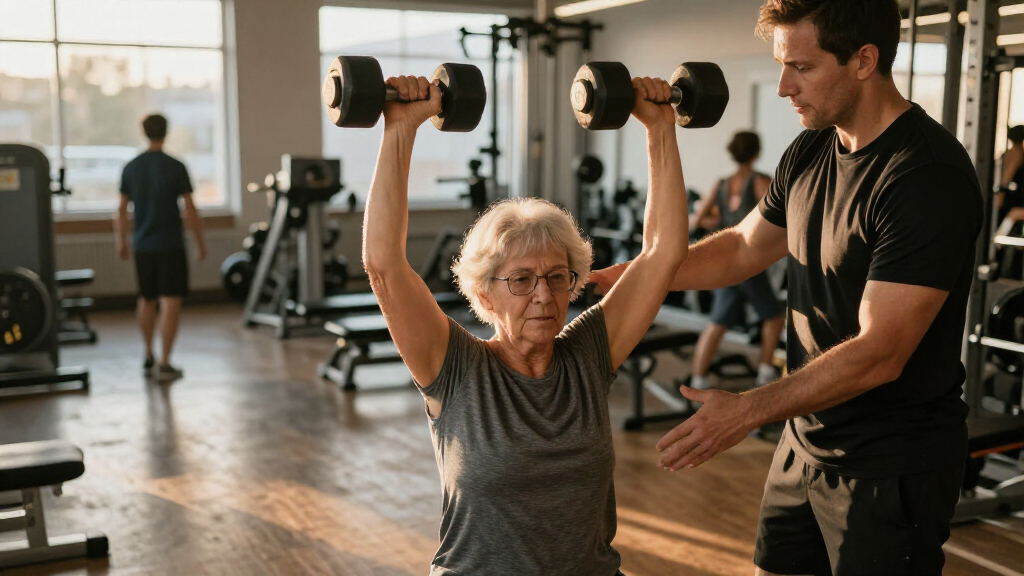
The trial compared a program of progressively harder strength exercises with a gentler exercise condition. Participants in the strength-training group worked against weights or their own body weight. In the second half of the program, they also performed some exercises on surfaces such as foam pads, adding a balance challenge. The study was assessor-blinded and sham-controlled, according to its title and publication details.
At the end of the program, the resistance-training group scored slightly higher on tests of immediate number recall and verbal fluency: participants had to repeat a string of numbers and name as many words beginning with the letter A as possible in one minute. The groups had similar results when asked to recall details from a story immediately and after 30 minutes.
The report describes the differences on the two tests as small. It does not establish that participants became more confident, more independent, or better able to manage routine activities. The study compared the full training program with gentler exercise, so it cannot isolate whether the strength exercises, the balance challenge, or another part of the program accounted for the test-score differences.
Resistance training may support thinking as adults age
A randomized trial found small differences on two thinking tests after progressive resistance training. It did not establish benefits for everyday life or dementia risk.
What the tests showed
Compared with gentler exercise, the resistance-training group scored slightly higher on two tasks.
- Immediate number recall
- One-minute word generation
- Story recall immediately
- Story recall after 30 minutes
How training worked
The trial compared the complete program with gentler exercise.
Participants used weights or their own body weight, with exercises becoming progressively harder.
In the second half, some exercises used surfaces such as foam pads.
What remains unknown
No functional result established
The test differences do not show better everyday memory, independence, or quality of life.
Not answered by this trial
The study did not establish whether training changes the chance of developing dementia.
Effects cannot be separated
The trial did not test strength exercises apart from the balance challenge.
Strength Training and Everyday Independence
The findings add evidence to research on exercise and thinking skills in older adults, but they do not show that resistance training prevents dementia. A change in performance on a particular test is not the same as a demonstrated change in memory-related difficulties at home, independence, or quality of life.
Strength can also matter for everyday movement. For some older adults, being better able to stand from a chair or carry groceries may support independence and participation in activities outside the home. Those effects depend on a person’s health, surroundings, and confidence, and were not established by the reported cognitive-test results.
The source material also notes that physical inactivity and social isolation are each associated with higher dementia risk. Strength training might help some people move around more easily and take part in social activities, but that possibility should not be confused with proof that exercise changes dementia risk.
Products Worth Considering

Coway Mighty Air Purifier AP-1512HH(W), White

Garmin Venu 3S GPS Fitness Smartwatch, 41 mm, French Gray

Oral-B iO Series 7 Deep Clean + Protect Rechargeable Electric Toothbrush, Black, with 2 Brush Heads and Charging Travel Case
As an affiliate, we earn on qualifying purchases.
How the Trial Tested Exercise
Mild cognitive impairment involves greater difficulty with memory or thinking than is typical for a person’s age, while many people can still manage most everyday tasks. The trial focused on adults aged 65 and older with probable mild cognitive impairment, rather than all older adults or people with diagnosed dementia.
Strength gains can occur before muscles visibly grow because the nervous system becomes more effective at activating muscles for practiced movements. Repeating an exercise can also improve performance on similar movements. That does not automatically mean the practice transfers to unrelated thinking skills: remembering an exercise sequence, for example, is different from learning and recalling new information.
Researchers have proposed several possible pathways linking strength exercise and brain health, including changes in blood pressure, the body’s response to insulin, inflammation, and signaling substances released by muscles. The source describes these as areas under investigation, not explanations proven by this trial. The study is identified as Dayane Tays da Silva and colleagues’ 24-week trial, published in 2027, with DOI 10.1016/j.jnha.2026.101030.
Limits of the Cognitive Findings
The reported results leave several questions open. The source does not provide the exact score differences, confidence intervals, or enough detail to judge how large the effects were beyond describing them as small. It is also unclear whether the test differences affect daily life.
The trial cannot determine whether the balance component contributed to the findings because it compared the complete resistance-training program with gentler exercise, rather than testing strength and balance components separately. The source also gives no evidence that the program changed participants’ dementia risk. Longer follow-up and measures of everyday function would be needed to address those questions.
The article’s broader discussion refers to research on possible biological pathways and to a review estimating that fewer than one in four adults did muscle-strengthening exercise at least twice weekly. That population estimate is separate from the trial and does not establish how common resistance training was among its participants or what its effects would be for other groups.
Longer Follow-Up Needed
The next evidence needed includes whether the cognitive-test differences persist beyond the 24-week training period, whether they translate into meaningful changes in everyday tasks, and whether resistance training affects dementia outcomes over time. Studies that compare strength training with and without balance challenges could help identify which parts of a program matter.
People considering a strength program can ask a health professional about an approach suited to their abilities and existing health conditions. The trial’s findings are not a guarantee of cognitive benefit, and the source does not provide a specific exercise prescription for individuals.
Key Questions
What did the study find?
After 24 weeks, the resistance-training group scored slightly higher than the gentler-exercise group on immediate number recall and a one-minute word-generation task. The groups had similar results on the story-memory tests.
Does resistance training prevent dementia?
This trial does not answer that question. It reported results on cognitive tests and did not establish whether training affects the chance of developing dementia.
Did the study show that participants became more confident or independent?
No such result is reported in the source material. It discusses possible links between strength, mobility, and independence, but those outcomes are not established by the cognitive-test findings.
Can the results be attributed to the balance exercises?
It is not clear. The study compared the full resistance-training program, which included some balance-challenging exercises, with gentler exercise. It did not test the balance element separately.
Source: medicalxpress.com