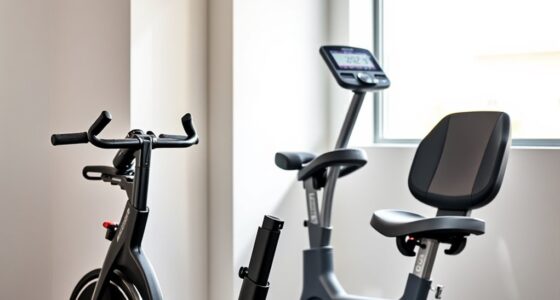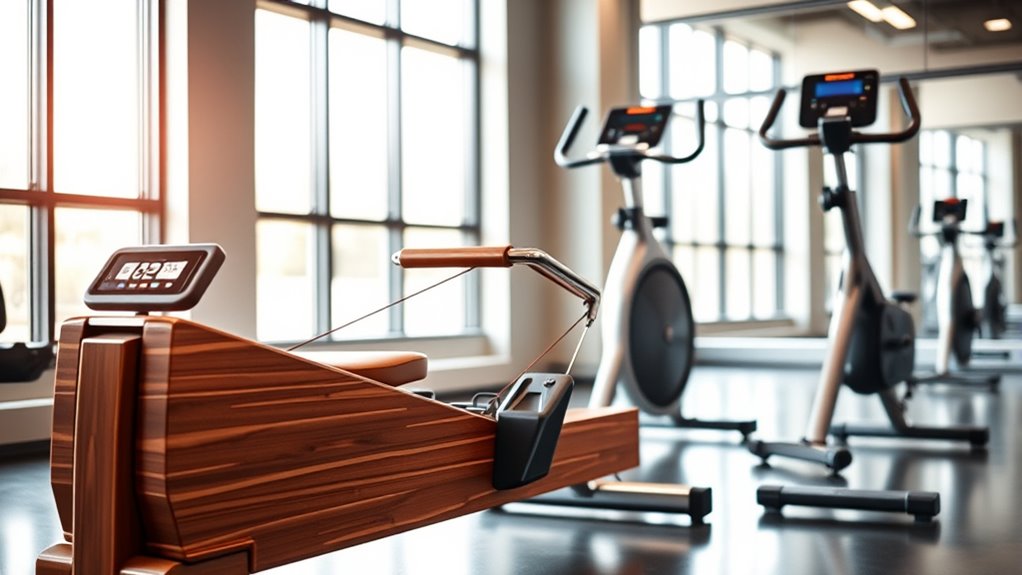

If you want a full-body, high-intensity workout that burns lots of calories quickly, a rowing machine is a strong choice since it involves your legs, core, back, and arms. On the other hand, if you prefer a lower-impact exercise focused mainly on your legs and endurance, a stationary bike is great, especially if you have joint concerns. To discover which option better fits your goals and preferences, explore the details that follow.
Key Takeaways
- Rowing provides full-body engagement, burning more calories and building strength faster than stationary bikes.
- Stationary bikes are lower-impact, making them ideal for joint health and injury recovery.
- Rowing allows quick intensity adjustments, suitable for high-intensity, full-body cardio workouts.
- Bikes target primarily lower-body muscles, offering effective cardio with less upper-body involvement.
- The best choice depends on fitness goals: full-body conditioning versus low-impact, targeted lower-body exercise.
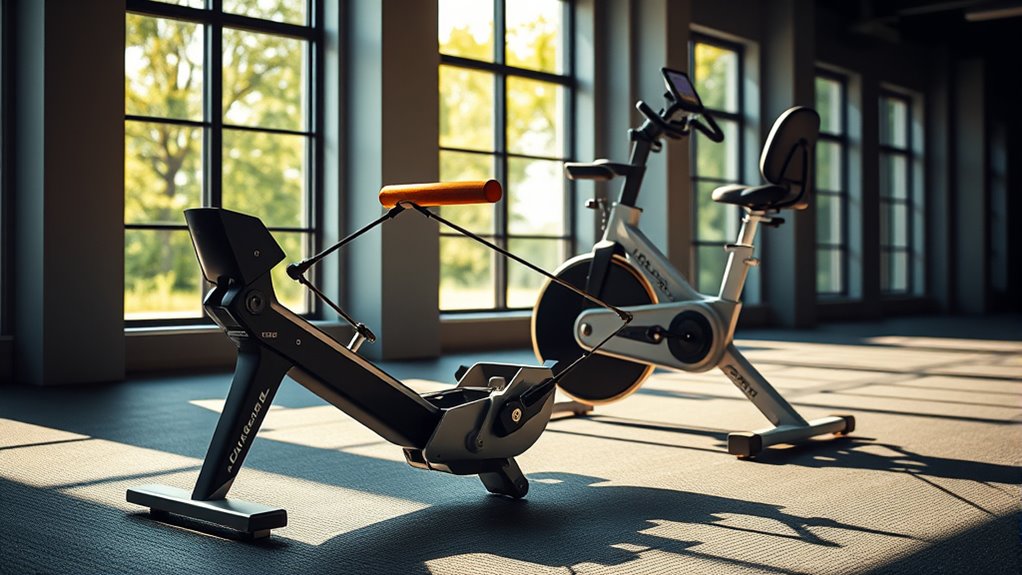
When choosing between a rowing machine and a stationary bike, understanding how each targets your fitness goals can help you make the right decision. Both options offer excellent cardiovascular workouts, but they differ markedly in terms of training intensity and muscle engagement. If you’re aiming to burn calories efficiently or build endurance, knowing these differences can guide your choice. Rowing machines provide a full-body workout, engaging multiple muscle groups simultaneously. During each stroke, you activate your legs, core, back, and arms, creating a high level of muscle engagement. This all-encompassing involvement means you can increase training intensity quickly, pushing your cardiovascular system and muscles to work harder in less time. The resistance on a rowing machine can be adjusted to match your fitness level, allowing you to ramp up intensity as you improve. As a result, rowing tends to deliver higher overall muscle activation, making it a great option if you want a workout that challenges your entire body. Additionally, modern rowing machines often incorporate advanced machine learning features to personalize workout programs and track your progress more effectively.
On the other hand, stationary bikes primarily focus on lower-body muscles, particularly your quadriceps, hamstrings, glutes, and calves. While they may not engage as many muscle groups as rowing machines, they still offer a solid cardiovascular workout. The training intensity on a bike is often controlled through resistance settings and pace, making it easier to tailor sessions to your current fitness level. If you’re recovering from an injury or prefer a lower-impact workout, a bike can be gentler on your joints while still providing effective cardio. However, because the upper body isn’t involved, the total muscle engagement is less compared to rowing. This can mean that, for the same duration, a rowing workout might burn more calories and build more muscle endurance across different areas.
Ultimately, your choice depends on your fitness goals. If you want a high-intensity, full-body workout that maximizes muscle engagement and overall calorie burn, rowing is likely the better pick. It allows you to increase training intensity quickly and challenge multiple muscle groups at once. Conversely, if you prefer a lower-impact exercise focusing on your lower body or need a gentler option for joint health, a stationary bike could suit you better. Both machines can be effective cardio tools, but your specific needs and goals will determine which aligns best with your fitness journey. Consider how much muscle engagement you want and how intense your workouts should be to help you make an informed decision that keeps you motivated and progressing.
Frequently Asked Questions
Which Machine Burns More Calories per Session?
You’ll burn more calories per session on a rowing machine compared to a stationary bike. The calorie comparison shows rowing engages more muscle groups, making your workout more efficient. Rowing also boosts your session efficiency since it combines cardio and strength training, helping you burn calories faster. If your goal is maximum calorie burn in less time, rowing gives you a better workout, especially for total-body conditioning.
Are Rowing Machines Suitable for Beginners?
Rowing machines are suitable for beginners because they offer beginner-friendly workouts and are easy to use. Many people worry about complexity, but most machines come with clear instructions and adjustable resistance, making them accessible. You can start with low-intensity routines and gradually increase difficulty. Their smooth motion and full-body engagement help build strength and endurance without overwhelming you, making rowing a great choice for newcomers to cardio workouts.
How Do These Machines Impact Joint Health?
You’ll find that both rowing machines and stationary bikes can impact joint health differently. Rowing machines tend to cause less joint stress if used correctly, providing low-impact exercise with potential long-term benefits for joint mobility. Stationary bikes also offer low-impact cardio, but improper form or resistance levels might lead to joint discomfort over time. Overall, both can be joint-friendly options when used properly, promoting healthy, sustainable workouts.
Can These Workouts Improve Overall Muscle Tone?
Yes, both workouts can improve your overall muscle tone. Rowing machines activate more muscle groups, including your back, arms, and core, offering high toning efficiency. Stationary bikes mainly target your legs and glutes, providing effective lower-body toning. To maximize muscle activation, incorporate varied intensities and resistance levels. Consistent use of either machine helps strengthen muscles, improve endurance, and enhance overall muscle tone, giving you a balanced, toned physique.
Which Machine Offers Better Options for Interval Training?
The rowing machine offers better options for interval training because it allows you to vary interval intensity more easily. You can switch between high-power sprints and slower recovery periods, providing greater workout variety. The stationary bike also works well, but rowing challenges multiple muscle groups simultaneously, making it more versatile for intense interval sessions. Whichever you choose, adjusting your effort levels keeps your workout engaging and effective.
Conclusion
Ultimately, whether you choose a rowing machine or a stationary bike depends on your goals and preferences. Think of it like picking your favorite flavor—each has its own unique benefits. If you want a full-body workout that feels like you’re rowing through the water, go for the rower. If you prefer a low-impact ride that still gets your heart pumping, the bike is your best bet. Whichever you choose, you’re steering yourself toward better health—your fitness journey, your rules.