TL;DR

Get workout gear delivered free with Prime
- Fast, free delivery on millions of items
- Prime Video, Amazon Music and more included
- Member-only deals all year
Researchers at Nottingham Trent University and Integrated System Technologies developed and tested a home-monitoring prototype that combines radar, thermal sensors and smart plugs. In a mock home, combining the sensor data improved activity-recognition performance; real-world emergency detection and its effect on independent living have not yet been established.
Nottingham Trent University researchers and technology company Integrated System Technologies have developed a home-monitoring prototype that combines radar, thermal sensors and smart plugs to identify activity patterns and possible emergencies without relying on cameras or wearable devices. The system was tested in a mock domestic setting, and the researchers report that using the sensors together improved performance; whether it can reliably detect emergencies in occupied homes remains unestablished.
The system uses millimeter-wave radar to detect movement, thermal sensors to identify broad postures such as sitting, standing, walking or lying down, and smart plugs to record appliance use associated with everyday routines. Examples include making a drink, preparing food or spending time at a desk. The research team says artificial intelligence combines these signals and learns an individual’s patterns over time, with unusual activity potentially prompting an alert to care professionals or relatives.
To limit identification, the thermal output is kept at low resolution and highly pixelated, according to the study description. The design does not use facial imagery, and its radar sensors can be placed discreetly around selected areas of a home. Researchers present the system as a possible alternative for monitoring that does not require a person to wear a device or be observed through conventional video.
Testing took place in a mock domestic environment with six room layouts, including bedrooms and living areas with different furniture arrangements. The researchers recorded a series of activities to assess movement and posture recognition. They report that the combined sensor information performed better than the technologies used separately. The study, titled “Privacy-Preserving Ambient Sensing for Activities of Daily Living: Multimodal Radar-Thermal Human Activity Recognition and Smart Plug Appliance Recognition,” was published in the journal Sensors.
How Home Monitoring Could Help
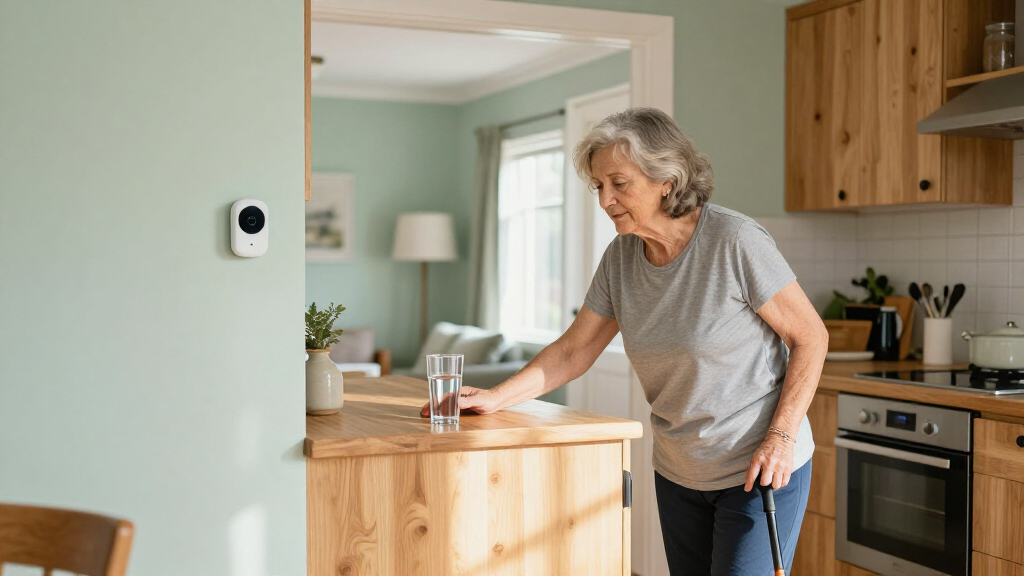
The proposed system addresses a practical challenge for older adults who want to remain at home: how to notice a possible crisis or worsening routine without requiring constant in-person observation. If further testing establishes reliable alerts, caregivers might be able to check on someone after a marked change in movement, prolonged inactivity or missing household routines. That could give families and care providers another source of information between visits.
The potential benefit is not yet a demonstrated outcome. The study reports sensor performance in a simulated setting, not evidence that the prototype has reduced injuries, prevented hospital visits or allowed people to live independently for longer. Any care decision would need to account for false alarms, missed events, the resident’s preferences and the availability of a person able to respond. The system is presented as a possible support for care, not a replacement for emergency services or human contact.
As an affiliate, we earn on qualifying purchases.
Three Sensors, One Household Pattern
The research was led by Dr. Yangang Xing of NTU’s School of Architecture, Design and the Built Environment, working with Integrated System Technologies Ltd. Other named contributors include company researchers Geoff Archenhold, Bilal Mohammed and Martin Harris, and NTU researchers Jordan J. Bird and Isibor Kennedy Ihianle. The paper appeared in Sensors in 2026 and is identified by DOI 10.3390/s26165066.
The approach combines different kinds of household signals because each sensor captures a limited part of a person’s activity. Radar registers movement, thermal sensing estimates posture, and smart plugs indicate when connected appliances are used. According to the researchers, joining those signals gave better results in their tests than relying on a single sensor type. The system’s intended next step in care would be to interpret changes against an individual’s usual pattern, rather than treating every resident as having the same routine.
Dr. Xing said the research aims to support older adults who wish to stay in their own homes rather than move into residential care. He also described the possibility of detecting gradual changes in mobility or routine, as well as acute events. Those are stated aims and potential uses; the published test described in the source was conducted in a mock home.
“By combining these three technologies, we can establish a complete picture of how someone is coping at home.”
— Dr. Yangang Xing, lead researcher at Nottingham Trent University
privacy-preserving home security sensors
As an affiliate, we earn on qualifying purchases.
As an affiliate, we earn on qualifying purchases.
Real-Home Performance Still Unknown
The reported evaluation was conducted in a mock home, and the source does not give enough detail to establish how accurately the system detects specific emergencies such as falls, strokes or heart attacks in everyday use. It also does not state how often alerts might be missed or incorrectly triggered, how the model performs across different residents, or whether results hold over long periods as routines change.
The publication summary does not specify a commercial launch, price, installation process, regulatory status or timetable for testing in occupied homes. It is also unclear how residents would consent to monitoring, how collected data would be stored and shared, and what safeguards would apply if the system misread ordinary behavior. The researchers describe privacy-oriented sensor design, but that is not the same as a complete account of data protection or proof that all privacy risks have been resolved.
elderly emergency detection sensors
As an affiliate, we earn on qualifying purchases.
As an affiliate, we earn on qualifying purchases.
Further Testing Needed at Home
The immediate next step is to test the prototype beyond the simulated room layouts and activity recordings described in the study. Assessments in real homes would need to establish whether the sensors work across different floor plans and household routines, and whether alerts are timely and useful to residents and caregivers. The source material does not announce a schedule for such trials.
Before the system could be treated as a dependable care tool, researchers and potential providers would also need to report its accuracy for distinct events, its false-alert rate, data-handling practices and how human responders act on notifications. Until those results are available, the device remains a research prototype with a proposed role in supporting independent living, rather than an established emergency-monitoring service.
As an affiliate, we earn on qualifying purchases.
Key Questions
How does the home sensor system work?
It combines radar for movement, thermal sensors for broad body posture and smart plugs for appliance-use patterns. The research team says AI combines the signals to compare activity with a person’s usual routine and identify unusual changes.
Does the system use cameras or wearable devices?
The described prototype is designed to work without conventional cameras or wearable devices. Its thermal output is kept low-resolution and pixelated, according to the study description, to avoid showing facial features or detailed images.
Has it been proven to detect falls or medical emergencies at home?
No. The study tested activity recognition in a mock domestic environment. The source describes emergency detection as an intended capability, but does not establish reliable performance for falls, strokes, heart attacks or other emergencies in occupied homes.
When will the system be available?
The report does not give a launch date, price or availability plan. It describes a research prototype, and further real-home testing would be needed to assess its practical use.
Source: rss
Halloween Picks
halloween
As an affiliate, we earn on qualifying purchases.