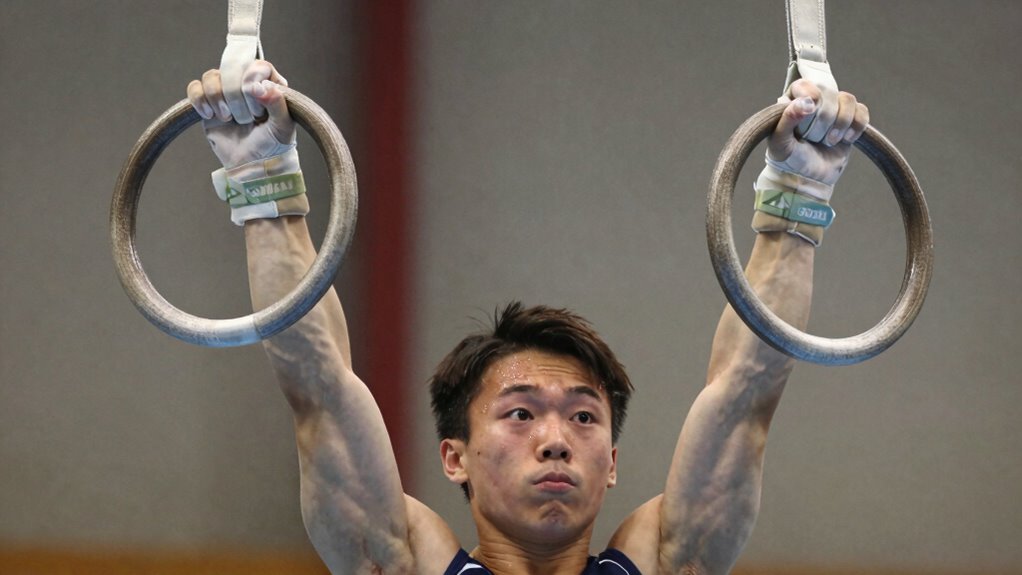

Gymnastic rings challenge your stability because their natural instability forces you to constantly activate stabilizer muscles, including your shoulders, core, and arms. As you move, small shifts require quick muscle adjustments, making every workout highly dynamic. This unpredictability improves your neuromuscular responsiveness and proprioception, creating a level of control hard to achieve with fixed weights. Keep exploring, and you’ll discover how this unique challenge boosts your strength and coordination more than traditional exercises.
Listen free for 30 days with Audible
Thousands of audiobooks and originals — cancel anytime.
As an affiliate, we earn on qualifying purchases.
Key Takeaways
- The rings’ inherent instability requires continuous muscle adjustments for balance and control.
- Their free rotation demands a strong grip, engaging stabilizer muscles to prevent slipping.
- Movements on rings activate multiple muscle groups simultaneously, challenging overall stability.
- Small shifts in position trigger rapid muscle firing, enhancing neuromuscular responsiveness.
- The unpredictable movement trains proprioception and enhances core engagement beyond traditional exercises.

Gymnastic rings are a versatile tool for building strength and improving stability, but they also challenge your balance like few other exercises can. When you perform movements on rings, you activate multiple muscle groups simultaneously, demanding a high level of muscle engagement. Unlike traditional weights, which provide stability through fixed paths, rings are unstable by nature. This instability forces your muscles to work harder to maintain control, especially in your shoulders, core, and arms. Your muscles don’t just lift or push; they constantly adjust to keep you balanced, making every movement more effective for building functional strength.
Gymnastic rings enhance strength and stability by challenging multiple muscle groups and demanding constant balance and control.
Grip strength plays a vital role when working with rings. Because the rings are circular and free to rotate, your hands must grip tightly to prevent slipping. A strong grip isn’t only about holding on—it directly influences your ability to stay stable during exercises like pull-ups, dips, or rows. As you hang or transition between movements, your grip strength limits how long you can perform exercises and how challenging they become. Improving your grip strength enhances your overall control, making it easier to stabilize yourself on the rings. This, in turn, leads to better muscle engagement throughout your workouts and helps prevent injuries caused by slipping or losing control.
The dynamic nature of rings means your body constantly adapts to small shifts in position. Even slight movements cause your muscles to fire in quick succession to keep you upright. This ongoing adjustment challenges your stabilizer muscles, which are often overlooked in traditional training. As a result, your core gets activated more intensely because it works to keep your torso steady while your arms and shoulders stabilize the rings. Over time, this integrated muscle engagement boosts your overall balance and coordination, making you more proficient in other physical activities.
Furthermore, the unpredictable movement of rings means that your balance isn’t static; it’s an active process. You learn to anticipate and counteract the rotations and swings of the rings, which trains your neuromuscular system. This improves your proprioception—the awareness of your body’s position in space—and enhances your ability to control your movements. It’s this constant need to stabilize that makes gymnastic rings such a powerful tool for challenging your stability. Your grip strength, muscle engagement, and neuromuscular control all work together, pushing your limits and helping you develop a level of stability that traditional exercises can’t match.
gymnastic rings for strength training
As an affiliate, we earn on qualifying purchases.
As an affiliate, we earn on qualifying purchases.
Frequently Asked Questions
Can Beginners Safely Use Gymnastic Rings?
Yes, beginners can safely use gymnastic rings by focusing on proper progression techniques and starting with equipment variations like adjustable rings. You should master basic exercises, ensuring proper form before advancing. Always begin with assisted or static holds, gradually increasing difficulty. Using proper equipment and following a structured progression helps you build stability and strength safely, reducing injury risk and making your ring training more effective and enjoyable.
What Are Common Mistakes When Training With Rings?
Like a tightrope walker overlooking a busy street, you might stumble into common mistakes when training with rings. You often neglect proper Ring grip, causing instability, or fail to guarantee full Muscle engagement, leading to poor form and potential injury. Rushing through exercises without control or ignoring core stability also hampers progress. Focus on deliberate movements, maintain a strong grip, and engage muscles fully to maximize safety and gains.
How Do Rings Improve Overall Strength?
Rings improve your overall strength by promoting intense muscle activation and core engagement. When you perform exercises on rings, you must stabilize your body, activating multiple muscle groups simultaneously. This dynamic challenge enhances your strength more effectively than fixed equipment. As you progress, your muscles become more balanced, and your core becomes stronger, leading to better functional strength and stability in other physical activities.
What Safety Equipment Is Recommended for Ring Training?
You should use safety equipment like wrist wraps and mats to prevent injuries during ring training. Progression techniques, such as gradually increasing difficulty, help you build stability securely. Equipment customization, like adjustable straps or padded grips, guarantees comfort and better control. Always inspect your gear before use, and consider spotters or a coach for advanced moves. This approach keeps your training safe while pushing your limits effectively.
How Often Should One Train With Gymnastic Rings?
You should train with gymnastic rings at least 2-3 times a week to see steady progress without risking burnout. Adjust the ring height based on your skill level and goals, and focus on mastering grip techniques to prevent slips. Consistency is key; think of it as building a fortress of strength. Balance your workouts, listen to your body, and you’ll develop impressive stability and control over time.
adjustable gymnastic rings with straps
As an affiliate, we earn on qualifying purchases.
As an affiliate, we earn on qualifying purchases.
Conclusion
So, next time you’re wobbling on those rings, just remember—you’re not just battling gravity, you’re fighting the very essence of balance itself. It’s like trying to keep your pizza toppings from sliding off—impossible, but oh so satisfying when you finally get it right. Embrace the chaos, because mastering stability on rings isn’t just about fitness; it’s about proving that even your shaky confidence can be gym-worthy. Keep hanging in there—you’re doing great!
gymnastic rings grip strength trainer
As an affiliate, we earn on qualifying purchases.
As an affiliate, we earn on qualifying purchases.
As an affiliate, we earn on qualifying purchases.
Flea & tick season Picks
flea and tick prevention
As an affiliate, we earn on qualifying purchases.