
You might be overlooking crucial muscles like your deep core stabilizers and scapular stabilizers, which are essential for maintaining proper posture and preventing injuries. Strengthening muscles such as the transverse abdominis, pelvic floor, serratus anterior, and rhomboids creates a stable foundation for all movement and helps avoid imbalances. Neglecting these can lead to long-term issues and reduced performance. If you want to discover how to incorporate them into your routine, keep exploring these essential, often skipped muscles.
Key Takeaways
- Small muscles around the hips and shoulders, like rotator cuff and hip stabilizers, are often neglected despite their crucial role in joint stability.
- Deep core muscles, such as transverse abdominis and pelvic floor, are frequently overlooked but essential for posture and injury prevention.
- Scapular stabilizers, including serratus anterior and lower trapezius, are vital for shoulder health but often receive insufficient attention.
- Overlooking these muscles can lead to imbalances, increased injury risk, and inefficient movement patterns.
- Incorporating targeted exercises for overlooked muscles enhances overall stability, performance, and long-term joint health.
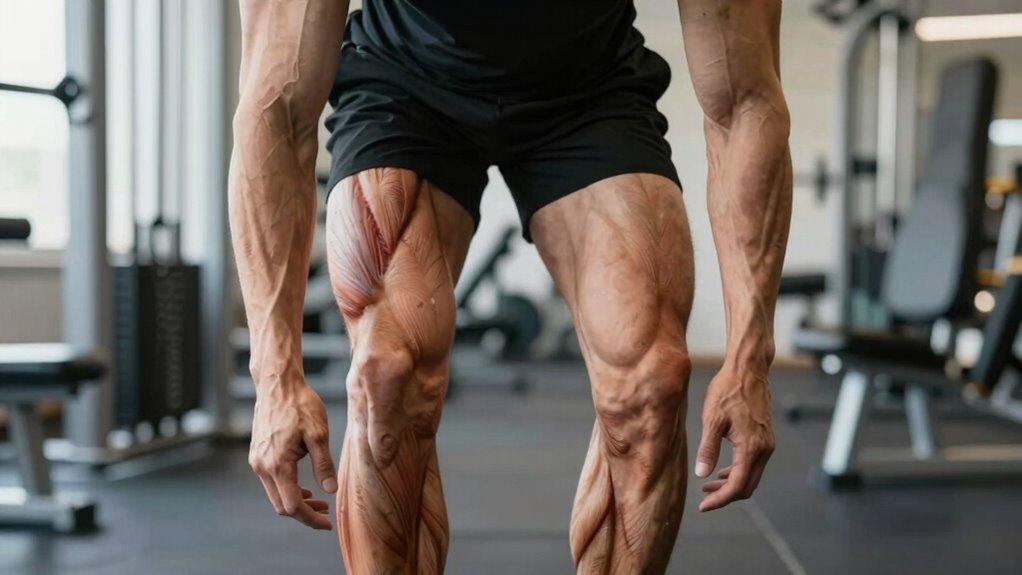
While most people focus on the major muscle groups like the chest, back, and legs, there are several overlooked muscles that can markedly enhance your overall strength and stability if trained properly. These smaller, often neglected muscles play a fundamental role in maintaining good posture and preventing injuries, yet they rarely get the attention they deserve. Neglecting them can lead to imbalances, increased vulnerability to strain, and long-term postural issues that affect your daily life and athletic performance.
One such group is the deep core muscles, including the transverse abdominis and the pelvic floor muscles. When you strengthen these muscles, you improve your posture correction, which is essential for reducing the risk of back pain and spinal misalignment. A strong core acts like a natural corset, supporting your spine and pelvis, and allowing you to move more efficiently. Incorporating exercises like planks, bird dogs, and gentle pelvic tilts can activate these muscles effectively. By doing so, you not only enhance your stability but also create a solid foundation for all other movements, making your training more balanced and injury-resistant. Additionally, understanding the role of smaller muscles in maintaining overall joint health can help you develop more comprehensive training routines.
Strengthening deep core muscles supports posture, reduces back pain, and creates a stable foundation for balanced, injury-resistant movement.
Another often overlooked muscle group is the scapular stabilizers, such as the serratus anterior, rhomboids, and lower trapezius. These muscles keep your shoulder blades in proper position, which is crucial for injury prevention, especially if you perform pushing or pulling movements regularly. Weakness here can lead to poor posture, shoulder impingements, or rotator cuff injuries. To target these muscles, incorporate exercises like scapular push-ups, face pulls, and rows with a focus on shoulder blade movement. Strengthening these stabilizers not only improves your posture correction but also guarantees your shoulders remain healthy and resilient during heavy lifting or repetitive activities. Furthermore, paying attention to the small muscles around your hips can significantly improve your overall movement mechanics and reduce injury risk during athletic activities. Additionally, understanding the role of smaller muscles in maintaining overall joint health can help you develop more comprehensive training routines.
deep core stabilizer exercises
As an affiliate, we earn on qualifying purchases.
As an affiliate, we earn on qualifying purchases.
Frequently Asked Questions
How Do I Identify if I’m Neglecting These Muscles?
You can identify if you’re neglecting these muscles by paying attention to muscle activation during your workouts—if certain areas feel weak or less engaged, they might be overlooked. Also, consider your posture correction; poor posture often indicates neglect of stabilizer muscles. Incorporate exercises targeting these muscles, and if you notice persistent imbalances or discomfort, it’s a sign you need to focus more on those overlooked areas.
Can Neglecting These Muscles Cause Injuries?
Neglecting these muscles can lead to injuries because muscle imbalance and postural issues often develop when certain muscles aren’t properly engaged. When your muscles are imbalanced, other parts of your body compensate, increasing strain and risk of strain or injury. To prevent this, incorporate exercises targeting overlooked muscles, maintain proper form, and regularly assess your posture to guarantee balanced strength and reduce injury risk.
What Are Easy Exercises for These Overlooked Muscles?
To target overlooked muscles, you can incorporate simple exercises like bird dogs, side planks, and bridges, which promote muscle activation without complex equipment. These exercise variations are easy to perform and effectively engage muscles often neglected in standard routines. Regularly including these exercises helps guarantee balanced strength, reduces injury risk, and improves overall stability. Start with low reps and gradually increase intensity as your muscle activation improves.
How Often Should I Train These Muscles?
You should aim to train these overlooked muscles 2 to 3 times a week to optimize muscle activation without risking overtraining. Incorporate targeted exercises into your routine, ensuring proper rest between sessions. This frequency allows your muscles to recover and grow stronger, while also maintaining balanced development. Adjust based on your progress and response, but generally, consistency and proper recovery are key for effective training of these often-neglected muscles.
Are There Specific Signs I Need to Strengthen These Muscles?
Did you know that 60% of adults experience muscle imbalances, often leading to poor posture? If you notice persistent aches, uneven shoulders, or difficulty maintaining proper alignment, these are signs you need to strengthen overlooked muscles. Addressing muscle imbalances through targeted exercises can aid posture correction, preventing injuries. Pay attention to your body’s signals, and incorporate specific strength training to restore balance and improve overall stability.
scapular stabilizer resistance bands
As an affiliate, we earn on qualifying purchases.
As an affiliate, we earn on qualifying purchases.
Conclusion
Don’t forget those overlooked muscles; they’re the hidden gears in your training machine. Think of your body like a Swiss watch—every part needs to work in harmony for precision. I once ignored my rotator cuff, and a simple shoulder injury sidelined me for weeks. Prioritize balanced training, and you’ll keep all gears turning smoothly, preventing breakdowns. Remember, the smallest overlooked muscle can be the weakest link—strengthen every part for overall success.
pelvic floor muscle trainer
As an affiliate, we earn on qualifying purchases.
As an affiliate, we earn on qualifying purchases.
rotator cuff shoulder exercises
As an affiliate, we earn on qualifying purchases.
As an affiliate, we earn on qualifying purchases.