TL;DR
Adjustable dumbbells combine multiple weight settings in one pair, which can save space and replace a rack of fixed weights in a home gym. Compare the weight range and increments, adjustment mechanism, dimensions, feel, and safety instructions against the exercises you plan to do; a high maximum weight alone does not make a set the right fit.
A pair of dumbbells can turn a corner of your living room into a workout space—but a full rack can take over the room. Adjustable dumbbells combine multiple weight settings in one pair, giving you a compact way to train without lining up a dozen fixed weights beside the sofa.

Get workout gear delivered free with Prime
- Fast, free delivery on millions of items
- Prime Video, Amazon Music and more included
- Member-only deals all year
This blog article will help you choose a set based on how you actually train: the weights you need, how quickly you want to change them, and whether their shape feels comfortable in your hands. You’ll also see what to check before buying, so a space-saving design doesn’t become an awkward fit for your exercises or storage nook.
Think of the adjustment system as the hinge of the whole setup: when it suits your routine, switching from light raises to heavier rows feels smooth. When it doesn’t, your workout can turn into a fiddly pause between every set. The key points for choosing well are practical—and easy to check before you order.
Check whether the advertised maximum weight refers to one dumbbell or the combined pair.
Compare the lightest setting and adjustment increments with movements such as lateral raises, presses, and rows.
Measure the dumbbells and their tray or stand, along with the room needed to handle them.
Try to match the dumbbell shape and balance to exercises where the weights sit close to your body.
Follow the manufacturer’s locking, storage, and care instructions; don’t assume a model can be dropped.
How Adjustable Dumbbells Save Space Without Replacing Every Tool
Adjustable dumbbells for a home gym let you select from several weights using a compact set of handles and plates, instead of storing one pair for every load. They can make strength training easier to fit into a spare room or apartment, though they won’t replace every piece of gym equipment. Think of them as a small toolbox for common lifting movements.
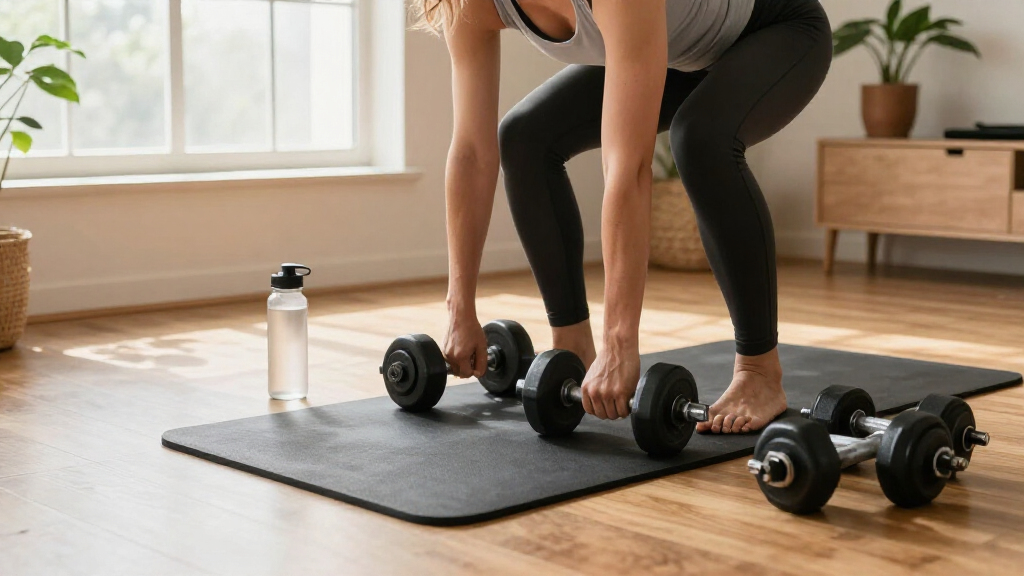
For example, if your workout includes curls, presses, and rows, one pair with several settings can cover all three without a line of weights under your desk. The space advantage matters most when the weights you need would otherwise require several pairs: a single storage spot can keep the room clear and make training easier to start. There is a practical tradeoff, though. The tray or stand occupies space, and you need clearance to lift the dumbbells out and return them without twisting or bumping nearby furniture. Measure the full setup, including that handling space, not just the stored footprint.
“Space-saving” also doesn’t mean “drop it anywhere.” A tray helps keep the weights organized and supports the adjustment system as designed; leaving a set on an unstable surface can make it harder to pick up safely or keep parts together. A clear patch of flooring gives you room to lift and set the weights down carefully. A bench, resistance bands, or heavier equipment may still make sense depending on the exercises and training goals you have in mind, so compact dumbbells are best viewed as one useful part of a home setup.
Small footprint, real setup: check the dimensions of the dumbbells, tray, and storage stand together—not only the advertised rack space.
Products Worth Considering

Levoit Vital 100S-P Air Purifier for Home and Pets

Garmin Forerunner 570 GPS Running Smartwatch, 42 mm, Aluminum Bezel, Bone/Mango

Therabody Theragun Relief Massage Gun, 3-Speed, Navy
As an affiliate, we earn on qualifying purchases.
Choose Weight Steps That Fit Your Exercises and Progress
Adjustable dumbbells work best when their lightest setting, heaviest setting, and increments all match your training. The maximum number on the box is only part of the story: a set that jumps in large steps may feel too heavy for small shoulder movements, even if it has enough weight for rows. That can leave you choosing between a load you can control and one that is too challenging, limiting how steadily you can progress. Check the full range before you buy.
Imagine starting lateral raises with a light setting, then using a heavier load for chest presses. Those exercises ask different things from your shoulders and arms, so smaller increments can help you make a modest increase when your control improves instead of forcing a large jump. Fine steps are especially useful for movements where a small change feels substantial; larger jumps may be less of a drawback for exercises where you can handle heavier loads. If your routine includes heavier lower-body work, also check whether the top setting gives you room to progress. A set that tops out early can save space now but may require a second purchase later.
Read the weight description carefully. An advertised maximum can refer to one dumbbell or to the combined pair, which makes two sets with similar-looking numbers very different. Confirming what the number describes tells you whether the set can provide the load each hand needs for your exercises. Some systems offer expansion kits, but they may cost extra and may not fit every version. Confirm compatibility and the final supported weight before you count on growing the set later.
A useful rule: write down three movements you do now, plus one you hope to progress on. Then compare each movement with the set’s available weight steps. Notice where the range or size of a jump could leave you without a manageable option. That quick check turns a vague “big enough” feeling into a concrete buying decision and helps you weigh flexibility against cost.
Compare Dial, Pin, and Spin-Lock Adjustments Before You Buy
Dial, pin, and spin-lock dumbbells change weight in different ways, so the best mechanism depends on how often you switch loads and how much handling you mind. Some selector systems let you change settings quickly; simpler designs may take longer because you move plates or collars by hand. That difference affects more than workout pace: repeated interruptions can make a circuit feel cumbersome, while a slower system may be perfectly manageable when you finish all sets at one weight before adjusting. Try to picture the mechanism in the middle of your actual workout.
Say you alternate between light curls and heavier rows. A fast selector can keep the session moving, while a spin-lock design may ask you to pause, loosen a collar, and adjust plates. That slower change may suit a straightforward routine where you perform several sets at one weight, and can also be attractive if keeping the purchase cost low matters more than quick transitions. Speed is useful, but it isn’t the only thing that matters: check how the weight locks, how clearly you can see the setting, and whether each dumbbell adjusts independently. A quick mechanism is only helpful if you can confirm the setting and engage it correctly every time.
| Mechanism | What to check | Routine it may suit |
|---|---|---|
| Selector dial | Clear settings and secure engagement | Frequent weight changes |
| Pin or selector pin | Easy alignment and a fully seated pin | Simple, repeatable adjustments |
| Spin-lock collar | Collar fit and time needed to change plates | Less frequent changes or tighter budgets |
These are broad design differences, not guarantees about every model. A dial or pin can reduce adjustment time, but the extra moving parts make the maker’s instructions and inspection routine important. A spin-lock requires more manual handling, yet its process may be easier to understand at a glance. Before choosing, read the manufacturer’s adjustment instructions and confirm what happens if a plate doesn’t seat correctly. A mechanism that feels obvious at home is far more useful than one that looks fast in an online clip.
Test the Grip and Shape Against Movements You Actually Do
Adjustable dumbbells can feel bulkier or less balanced than fixed dumbbells, depending on their handle, plate shape, and selected weight. Grip thickness and knurling—the texture on the handle—can change how secure a dumbbell feels in your hand. Those details matter because an awkward grip or shifting balance can distract you from controlling the movement, particularly as fatigue builds. If possible, hold the model or check its measurements before committing.
For example, a pair might feel fine during standing curls but bump into your shoulders when you bring the weights into position for a press. That contact can make setup uncomfortable or change how you position your arms, even if the weight itself is manageable. Some compact designs aim for a more familiar fixed-dumbbell feel, while other models extend plates farther from the handle. Neither style suits everyone; the movement and your body position matter.
Check product dimensions and look for demonstrations of your planned exercises. Bench presses, shoulder presses, and movements where the weight rests near your body can expose shape or clearance issues that a basic curl won’t. If your main lifts require the weights to sit close to your shoulders, a few extra inches of width can matter more than a familiar-looking handle. A return policy can also matter if you can’t try the set first, because measurements and demonstrations cannot fully predict how a dumbbell will feel in your hands.
Match the dumbbell to your movement, not just your hand. A comfortable grip is a good start, but balance and clearance help determine whether you’ll enjoy using the set across a full session. If one exercise feels cramped with the model you’re considering, choose another design or plan to use a different tool for that movement. That compromise may be reasonable if the exercise is occasional; if it is central to your routine, the fit should carry more weight in your decision.
Use a Simple Checklist to Compare Total Cost and Storage
Compare the full price and footprint of an adjustable set with the fixed weights it would replace. The sticker price won’t tell you whether a stand, expansion kit, shipping, or warranty changes the value. Likewise, a compact pair still needs a stable place to rest between sets. Looking at the whole setup helps avoid paying for a low entry price that grows once necessary accessories are added.
Suppose your only available space is a narrow shelf beside a workout mat. A pair that fits there may still need a tray wider than the shelf, or extra room to lift the weights out without hitting a wall. Measure the dumbbells and their storage setup, then compare that with the area you actually have—not a tidy product photo. If the set fits only when stored but is awkward to handle, you may end up avoiding it or spending time rearranging the room before every workout.
- List your exercises and the light and heavy settings each one needs.
- Compare the weight range and increments, and check whether the maximum applies to one dumbbell or the pair.
- Measure the full setup, including the tray or stand and the space needed to handle it.
- Add the complete cost of included accessories, expansion options, delivery, and warranty terms.
- Review the care and return instructions before you settle on a model.
This checklist can reveal when a simpler design is the better buy. If you usually change weights once per workout, a slower, less expensive mechanism may do the job and leave more of your budget for other equipment. If you switch loads repeatedly, a quick selector could be worth paying more for by reducing downtime—provided its shape and range also fit your training. The best value is the set you can store, adjust, and use comfortably over time, not necessarily the one with the most settings or the lowest starting price.
Keep the Mechanism Secure With a Few Simple Habits
Adjustable dumbbells are safe to use when you follow the manufacturer’s instructions and make sure the plates or selector are fully locked before lifting. Treat the adjustment mechanism like a latch: it needs to be properly engaged before the weight leaves its tray. If a plate is not secured, it may shift or detach during a movement, which can cause injury or damage. Never force a dial, pin, or collar that doesn’t move as expected.
Before a set, glance at the selected weight and confirm the mechanism is seated. This brief check helps catch a setting or locking issue before the dumbbell is in motion. Set each dumbbell down carefully and return it to its tray if the instructions call for one. Many models are not designed to be dropped, and an impact can damage plates, trays, or moving parts even when the outside looks fine afterward. Hidden damage could affect how securely the mechanism holds the next time you lift.
For instance, after changing plates on a spin-lock model, take a moment to check that the collar sits as the manual directs before your next set. Keep adjustment areas clear of debris and follow the maker’s cleaning and storage advice. Periodically inspect the mechanism and stop using a weight if something looks loose or doesn’t engage properly. These habits take little time and help preserve the parts that keep the selected weight together.
Safety check: don’t lift with a partly engaged selector or drop a dumbbell unless the manufacturer specifically says the model is built for impact.
If you have a pre-existing health condition or questions about starting a fitness routine, ask a qualified professional for guidance that fits your situation. Choose a weight you can handle with control, and change it in steps that feel manageable for your exercise.
Frequently Asked Questions
Are adjustable dumbbells worth it for a home gym?
They can be a good fit when space matters and you want several weights in one pair. Their value depends on the range, adjustment speed, build, and total cost compared with the fixed weights you would otherwise buy.
What weight range should I choose?
Choose settings that suit the exercises you do now and leave room for your planned progress. Beginners may want manageable light settings, while people doing heavier rows or lower-body exercises should check whether the top setting is enough.
Are adjustable dumbbells safe?
They can be safe when used as directed and when plates or selectors are fully locked before lifting. Don’t force an adjustment mechanism, and follow the manufacturer’s instructions for setting weights down and storing the dumbbells.
Can I drop adjustable dumbbells?
Only if the manufacturer says that specific model is designed to handle drops. Impact can damage plates, the tray, or the adjustment mechanism, so check the manual instead of assuming the set can take it.
Do adjustable dumbbells feel like regular dumbbells?
It depends on the design. Handle thickness, plate shape, and balance can make one model feel familiar and another feel bulky, especially during presses or movements where the weights rest near your body.
Can I expand an adjustable dumbbell set later?
Some systems offer expansion kits, but they can require a separate purchase and may fit only certain versions. Confirm compatibility, added cost, and the maximum supported weight before choosing a set based on future expansion.
Conclusion
Choose adjustable dumbbells by matching their weight steps, mechanism, feel, and full storage footprint to the workouts you plan to do. A large maximum weight won’t help if the smallest setting feels too heavy or the shape crowds your presses.
Before you buy, check those details against three real exercises and the corner where you’ll store the set. Then your home gym can stay compact, ready, and pleasantly clear of a whole rack of weights.