To improve your freestyle and swim faster, focus on controlled breathing and full arm extension. Coordinate your breath with arm recovery, exhaling underwater and inhaling smoothly as your hand enters the water. Keep your body horizontal and aligned for better propulsion, and make certain your arm extends fully forward before pulling. Incorporate drills like fingertip drag and side-kicks to refine technique. Mastering these tips will boost efficiency—continue exploring to enable even more ways to enhance your swim speed.

Get workout gear delivered free — and shop member deals
- Fast, free delivery on millions of items
- Access to Prime Big Deal Days deals on October 6–7
- Prime Video, Amazon Music and more included
Key Takeaways
- Practice controlled, rhythmic breathing to enhance stroke fluidity and conserve energy during each lap.
- Achieve full arm extension before pulling to maximize propulsion and reduce drag.
- Coordinate breathing with arm recovery, exhaling underwater and inhaling efficiently at entry.
- Maintain a streamlined, horizontal body position to improve efficiency and reduce resistance.
- Incorporate drills like fingertip drag and side-kick to refine technique and build speed.
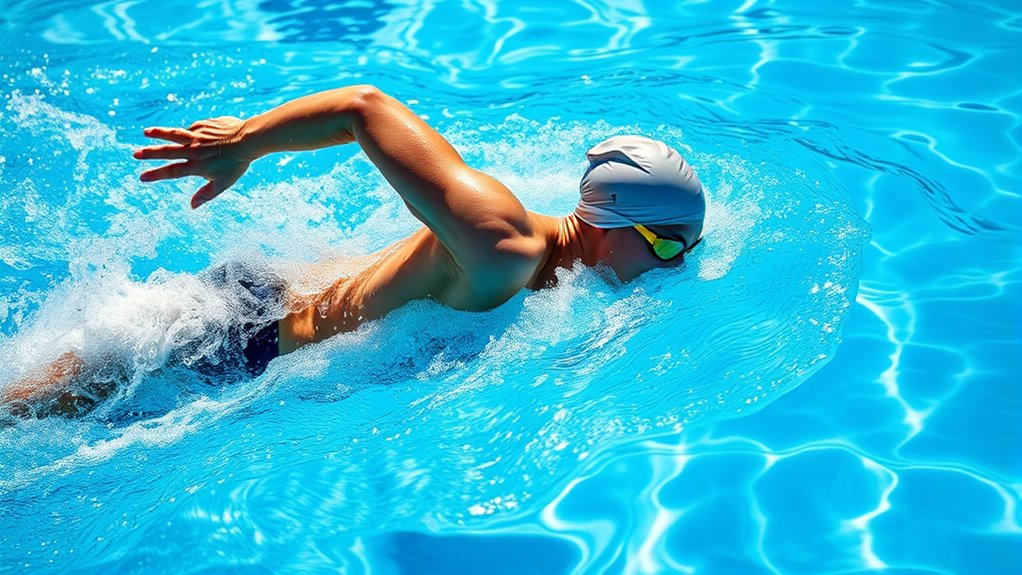
Improving your swim stroke speed requires focusing on technique and efficiency. One of the most critical elements is mastering your breathing techniques, which directly impact your rhythm and overall momentum. Instead of holding your breath or gasping awkwardly, work on controlled, rhythmic breathing that syncs seamlessly with your arm movements. Practice bilateral breathing—alternating sides—so you develop a balanced stroke and prevent fatigue on one side. When you breathe in, do so quickly but smoothly, turning your head just enough to clear your mouth from the water without disrupting your body’s alignment. Exhale steadily underwater, which allows you to breathe in swiftly when you turn your head again. This consistent breathing pattern keeps your stroke fluid and helps conserve energy, enabling faster speeds over longer distances.
Equally important is focusing on proper arm extension. When your arm enters the water, aim for a full extension forward before beginning your pull. Extending your arm fully in front of you maximizes your reach and propels you further with each stroke. It also helps maintain a streamlined body position, reducing drag and increasing efficiency. As your hand enters the water, keep it aligned with your shoulder and extend forward with a slight downward angle, avoiding early bends at the elbow. Proper arm extension creates a longer pull, which translates into more propulsion with less effort. To improve this, focus on reaching as far as possible with each stroke, imagining you’re trying to touch the farthest wall ahead of you. This mindset encourages a full extension and a more powerful pull.
Focus on full arm extension to maximize reach and propulsion with each stroke.
Integrating effective breathing techniques with consistent arm extension creates a rhythm that boosts your stroke speed. During each cycle, coordinate your breath with your arm recovery—exhaling underwater while your arm recovers and inhaling as your arm enters the water. This synchronization minimizes unnecessary pauses and keeps your swim smooth and fast. Additionally, work on your body position to keep yourself horizontal in the water, which makes it easier to extend your arms fully and breathe efficiently without losing momentum. Focus on maintaining a relaxed, streamlined posture to reduce resistance and maximize your forward movement. Developing an awareness of your body position can significantly improve your overall stroke efficiency and speed.
Incorporate drills that emphasize these elements, such as side-kick drills for breathing and fingertip drag drills for arm extension. Over time, refining your breathing techniques and arm extension will become second nature, allowing you to swim faster with less fatigue. Remember, every improvement in your technique directly translates into increased speed and efficiency, so stay consistent and attentive to these details as you train.
swimming hand paddles for freestyle
As an affiliate, we earn on qualifying purchases.
As an affiliate, we earn on qualifying purchases.
Frequently Asked Questions
What Are Common Mistakes That Hinder Swim Stroke Speed?
You often hinder your swim stroke speed by poor body position and inefficient arm movement. If you let your hips sag or your head lift too high, you create drag, slowing you down. Additionally, rushing arm recovery or not extending your arm fully during the pull reduces propulsion. Focus on maintaining a streamlined body and smooth, controlled arm movements to increase your speed and efficiency in the water.
How Does Breathing Technique Affect Swimming Efficiency?
Your breathing technique substantially impacts your swimming efficiency. By maintaining a steady breathing rhythm, you guarantee consistent oxygen intake, preventing fatigue. Focus on exhaling fully underwater and inhaling quickly when turning your head, which maximizes lung capacity. Proper breathing reduces energy wastage, allowing you to swim faster and more smoothly. Improving your breathing rhythm and expanding your lung capacity directly enhances your overall swim performance and endurance.
Can Strength Training Improve My Swim Speed?
Yes, strength training can boost your swim speed. It enhances your muscles, making you more powerful against water resistance. Focus on swimming gear like resistance bands and weights to target key muscles. Incorporate exercises that improve core, shoulder, and leg strength. Stronger muscles help you push through water more efficiently, reducing drag and increasing speed. Just remember to balance strength training with proper technique and recovery for ideal results.
What Role Does Flexibility Play in Swimming Performance?
Flexibility is your secret wind beneath your wings, allowing smoother, more effortless strokes. When you incorporate stretching routines and flexibility exercises into your training, you release a greater range of motion, reducing resistance and increasing efficiency. Think of your muscles as elastic bands—when they’re flexible, you can propel yourself forward faster and with less fatigue. Prioritizing flexibility helps you glide through water with grace, making each swim feel like a dance rather than a struggle.
How Can Mental Focus Enhance My Swim Stroke?
Mental focus boosts your swim stroke by helping you stay present and execute techniques with precision. Use visualization techniques to picture your perfect stroke, which reinforces muscle memory and confidence. Building mental resilience allows you to push through fatigue and setbacks, maintaining concentration during training and races. When you stay focused, you improve your timing, streamline your movements, and ultimately swim faster with better efficiency and control.
swimming fins for technique training
As an affiliate, we earn on qualifying purchases.
As an affiliate, we earn on qualifying purchases.
Conclusion
Just like Icarus soaring higher with wings crafted from determination, you can elevate your swim stroke with these tips. Embrace each practice as a step toward mastery, and don’t let setbacks anchor you down. Keep pushing forward, trusting in your effort and progress. Before long, you’ll glide through the water like a swimmer chasing the horizon—faster, stronger, and more confident. So plunge in, and let your improved stroke carry you to new heights.
swim snorkel for breathing practice
As an affiliate, we earn on qualifying purchases.
As an affiliate, we earn on qualifying purchases.
swimming pull buoy for stroke improvement
As an affiliate, we earn on qualifying purchases.
As an affiliate, we earn on qualifying purchases.
Fall Picks
fall essentials
As an affiliate, we earn on qualifying purchases.