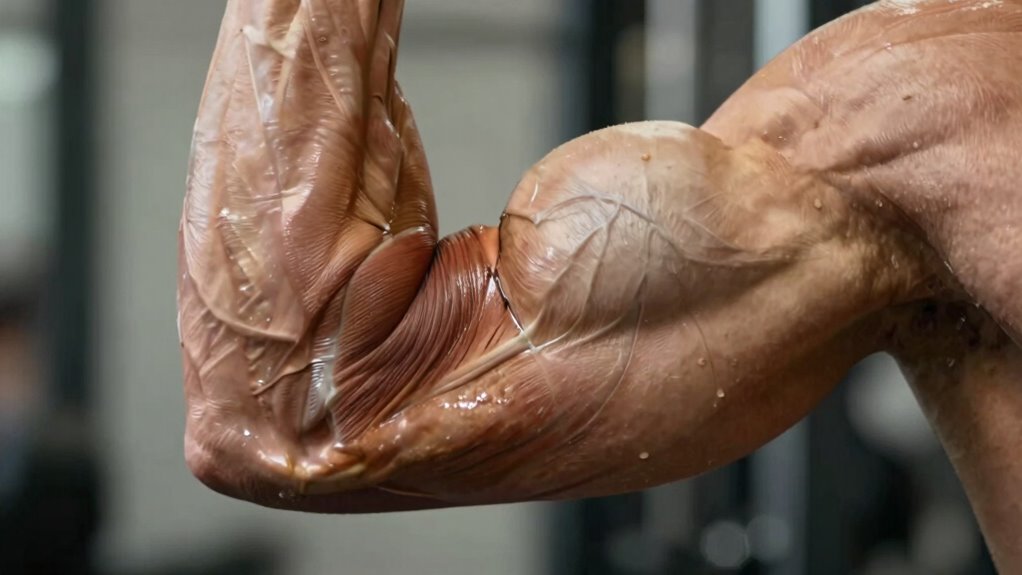

Mechanical tension is your main trigger for muscle growth, signaling your body to adapt by increasing fiber size and strength. When you lift heavy or slow, it creates stress that sparks cellular repair and hypertrophy. Maintaining proper form and progressive overload is key to keeping tension high throughout your workout. This continuous challenge prompts your muscles to become stronger and bigger over time. Keep going, and you’ll discover more about harnessing tension to maximize your gains.

Get workout gear delivered free with Prime
- Fast, free delivery on millions of items
- Prime Video, Amazon Music and more included
- Member-only deals all year
Key Takeaways
- Mechanical tension signals muscle fibers to adapt by activating growth-related cellular pathways.
- Sustained tension during exercises promotes hypertrophy through structural fiber changes.
- Proper technique maximizes tension within muscle fibers, enhancing growth signals.
- Progressive overload maintains high tension levels, stimulating continuous muscle development.
- Consistent tension across sets and sessions ensures ongoing cellular repair and hypertrophy.

Have you ever wondered what truly triggers muscle growth? It all boils down to how your muscles respond to mechanical tension. When you lift weights or perform resistance exercises, you create tension within your muscle fibers. This tension acts as a signal for your body to adapt, leading to muscle growth over time. The key process here is fiber adaptation—a series of changes your muscle fibers undergo to handle increased loads more effectively. As you consistently challenge your muscles, fibers respond by becoming stronger and larger. This process isn’t random; it’s driven by tension signaling, a mechanism that tells your body to reinforce and build up muscle tissue.
When you apply tension during exercise, your muscle fibers experience micro-tears and stress that activate cellular pathways responsible for growth. Tension signaling stimulates the production of proteins involved in muscle repair and hypertrophy. The more tension you generate, especially when lifting heavy or performing slow, controlled movements, the greater the stimulus for fiber adaptation. Your muscles essentially “learn” to handle heavier loads, leading to increased muscle mass and strength. This is why progressive overload—gradually increasing weights or reps—is so crucial; it keeps tension levels high enough to continually signal your body to adapt. Additionally, muscle fiber response depends on maintaining consistent tension throughout each set, which maximizes stimulation and promotes optimal growth.
Furthermore, tension isn’t just about lifting heavy; it’s about maintaining sufficient force throughout each movement. If you perform exercises with light weights or poor form, you won’t generate enough tension to activate these growth signals. That’s why proper technique and intensity matter. By focusing on controlled, deliberate movements, you maximize tension signaling within your muscle fibers. This mechanical tension is fundamental to muscle hypertrophy because it directly triggers the cellular processes necessary for growth. It’s also supported by the fact that fiber adaptation is a highly regulated biological process, influenced by various signaling pathways that respond to tension stimuli. The role of tension signaling in muscle development is further emphasized by the importance of training volume, which helps sustain tension over multiple sets and sessions. Consistent and appropriate tension application is essential for muscle growth because it ensures your body receives a clear signal to initiate repair and growth processes. Over time, this sustained tension causes your fibers to adapt by increasing their size and strength, making your muscles more resilient and capable of handling even greater loads.
adjustable dumbbells for muscle growth
As an affiliate, we earn on qualifying purchases.
As an affiliate, we earn on qualifying purchases.
Frequently Asked Questions
How Quickly Does Mechanical Tension Induce Muscle Hypertrophy?
You can start noticing muscle hypertrophy within a few weeks of consistent training that applies mechanical tension. When you lift weights, your muscles experience tension that causes muscle elasticity and stimulates tendon adaptation. This process signals your body to strengthen and grow muscle fibers. However, the rate varies depending on your training intensity, nutrition, and genetics. Stay consistent, and you’ll see gains as your muscles adapt to the mechanical tension over time.
Can Mechanical Tension Cause Injury if Overdone?
Think of your muscles as a delicate bridge under stress—too much tension risks damage. Overdoing mechanical tension can cause injury, especially if you ignore muscle soreness signals. Pushing too hard increases injury risk, weakening the very foundation you’re trying to build. Listen to your body, ease up when needed, and prioritize proper form to prevent setbacks and make certain of steady, safe progress.
What Are the Best Exercises to Maximize Mechanical Tension?
To maximize mechanical tension, focus on exercises that recruit the most muscle fibers and hit tension thresholds, like heavy compound lifts such as squats, deadlifts, and bench presses. These exercises create high tension levels, stimulating muscle growth. Incorporate slow, controlled movements to maintain tension throughout each rep. Progressive overload is key—gradually increase weight or reps to keep challenging your muscles and promote ideal muscle fiber recruitment.
Does Mechanical Tension Affect Different Muscle Fibers Equally?
You might think all muscle fibers respond equally to tension, but ironically, their recruitment and tension distribution aren’t uniform. Fast-twitch fibers often get the lion’s share during high-intensity lifts, while slow-twitch fibers engage more in endurance activities. So, mechanical tension affects different fibers differently, making your workout’s impact more nuanced. To maximize growth, you need varied stimuli that target all fiber types through strategic tension distribution.
How Does Age Influence the Response to Mechanical Tension?
As you age, your response to mechanical tension diminishes due to age-related decline in muscle regenerative capacity. Hormonal interactions, like decreased testosterone and growth hormone levels, also affect how effectively your muscles adapt to tension. This means you might need more targeted training and recovery strategies to stimulate growth. Staying consistent and adjusting your workouts can help counteract these age-related changes and maintain muscle strength and size over time.
resistance training equipment for hypertrophy
As an affiliate, we earn on qualifying purchases.
As an affiliate, we earn on qualifying purchases.
Conclusion
In essence, embracing mechanical tension is like wielding a sword in a medieval duel—you push your limits, forcing your muscles to adapt and grow stronger. Without this essential force, your efforts are like a ship sailing without wind, destined to stay stagnant. So, stay committed, keep lifting, and remember that every rep is a step closer to the legend you’re destined to become. In the end, your gains are the true treasure in this modern-day quest for strength.
weightlifting belts for heavy lifting
As an affiliate, we earn on qualifying purchases.
As an affiliate, we earn on qualifying purchases.
As an affiliate, we earn on qualifying purchases.
Halloween Picks
halloween
As an affiliate, we earn on qualifying purchases.